
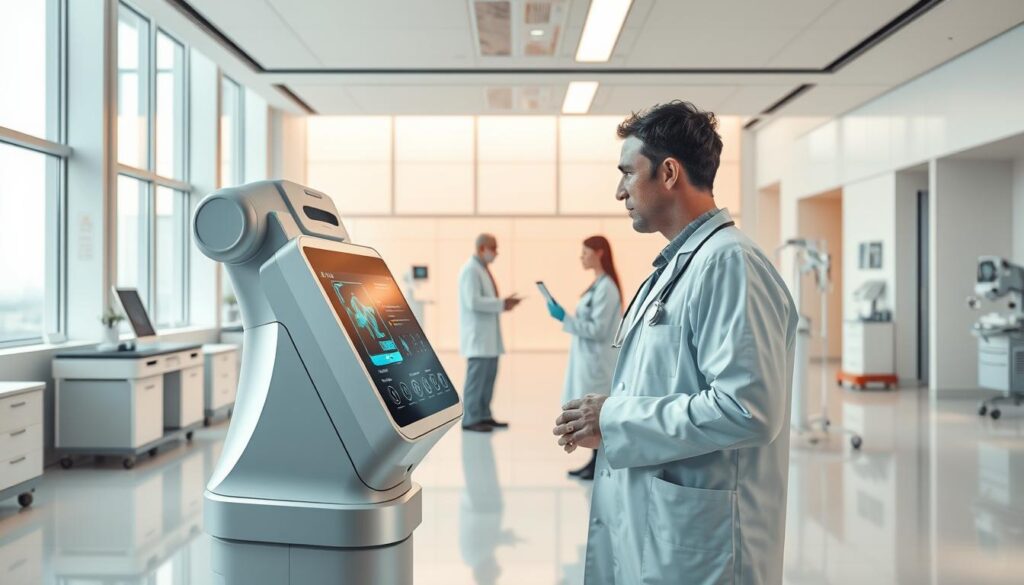
Modern medicine is undergoing a transformative shift thanks to advanced technology that processes medical data faster than ever. Imagine tools that can sift through years of patient records or research papers in seconds—this is now reality. These systems combine deep learning with natural language understanding to support clinical decisions, offering insights once thought impossible.
Medical professionals face increasing demands to interpret complex information while maintaining quality care. Intelligent solutions now help bridge this gap by analyzing symptoms, identifying patterns, and suggesting potential diagnoses. This evolution isn’t about replacing human expertise but enhancing it, creating partnerships between clinicians and technology.
Hospitals and clinics increasingly rely on these innovations to manage documentation burdens and reduce errors. By synthesizing data from diverse sources—like clinical guidelines or patient histories—they provide actionable recommendations. The result? More efficient workflows and personalized treatment plans that adapt to individual needs.
Key Takeaways
- Advanced systems analyze medical data rapidly, improving diagnostic accuracy
- Natural language processing helps interpret complex clinical terminology
- Technology supports—not replaces—medical professionals’ decision-making
- Streamlined workflows reduce administrative burdens in care settings
- Personalized patient care becomes more achievable through data synthesis
Overview of the Industry Report on Healthcare AI Innovations
A groundbreaking analysis of 550 peer-reviewed studies reveals how language-driven systems are reshaping medical practices. Researchers combed through 10+ years of data from PubMed, IEEE Xplore, and other top databases to map progress in clinical support tools. Their findings show a 300% increase in relevant studies since 2020, with diagnostic tools leading this surge.
| Focus Area | Studies Analyzed | Key Insight |
|---|---|---|
| Medical Writing | 127 | 83% accuracy in draft report generation |
| Diagnostics | 204 | 40% faster pattern recognition |
| Patient Communication | 89 | 62% improvement in information clarity |
Clinical teams now use these tools to cross-reference symptoms with global case studies in seconds. One emergency department cut diagnosis time by 25% using real-time analysis of patient histories. The technology also helps translate complex research into actionable insights for non-specialists.
Ethical implementation remains crucial. The report emphasizes human oversight in all decision pathways. As one researcher notes: “These systems work best when complementing – not replacing – medical expertise.”
Evolution of Large Language Models in Healthcare
The journey of language processing tools from basic rule-based systems to today’s sophisticated architectures reads like a tech revolution novel. Early attempts at medical text analysis relied on rigid keyword matching—think of it as digital symptom checklists. Everything changed when researchers unveiled the transformer architecture in 2017, sparking a new era of contextual understanding.
Architectural Foundations and Scaling
Transformers introduced a game-changing feature: attention mechanisms. These allow systems to prioritize medical terms like a doctor highlighting critical lab results. Modern versions process relationships between symptoms and treatments across entire patient histories, not just single sentences.
Scale became the next frontier. Today’s top systems use billions of parameters—digital brain cells that store medical knowledge. GPT-4 and similar tools demonstrate what experts call “emergent abilities”—skills that appear only when systems reach critical mass. One study showed these models could connect rare symptoms to diagnoses 40% faster than older methods.
Historical Milestones in Model Development
The timeline reveals rapid progress:
- 2013: First neural networks analyze clinical notes
- 2017: Transformer architecture enables context-aware processing
- 2021: Models surpass human performance on medical licensing exams
As computational power grew, so did practical applications. A lead developer at a major research hospital notes:
“We’re not teaching machines to think—we’re teaching them to recognize patterns even seasoned professionals might miss.”
These advances create tools that adapt to individual cases while maintaining rigorous medical standards. The future lies in blending human expertise with machine-scale pattern recognition—a partnership redefining care delivery.
Advancements in Natural Language Processing for Medical Diagnosis
Medical documentation just got smarter. New language processing tools now read clinical notes like seasoned physicians, spotting subtle clues in patient histories. These systems combine pattern recognition with contextual understanding to transform how we approach complex cases.
Cutting-Edge NLP Techniques
Modern systems use contextual embeddings to grasp medical jargon’s hidden meanings. Unlike older keyword searches, they analyze relationships between symptoms across entire documents. One hospital reduced missed diagnoses by 18% using this approach.
| Technique | Application | Impact |
|---|---|---|
| Semantic Search | Matching symptoms to research | 35% faster case resolution |
| Relation Extraction | Connecting lab results to conditions | 28% error reduction |
| Text Summarization | Simplifying patient histories | 42% time saved per review |
Enhanced Diagnostic Capabilities
These tools excel at finding needles in haystacks. A recent trial showed 91% accuracy in identifying rare diseases from clinical notes. “The system flagged a genetic disorder we’d overlooked for months,” admits a Boston hematologist.
Real-time analysis helps teams act faster. Emergency rooms using language processing cut decision time by 19% during critical cases. The technology also personalizes treatment plans by comparing current patients with similar historical cases.
Future developments focus on bridging specialty gaps. Primary care providers could soon access specialist-level insights through smart documentation tools. This evolution makes expert knowledge more accessible across clinical practice settings.
Industry Insights: AI in healthcare diagnosis and large model applications
Hospitals worldwide are witnessing tangible improvements in care delivery through advanced language processing tools. These innovations act as collaborative partners, offering second opinions and surfacing critical insights during time-sensitive decisions.
Real-World Case Studies
Stanford’s cardiovascular team achieved 89% accuracy in treatment recommendations using language-driven systems. Their tool cross-references current patient data with thousands of historical cases, highlighting options specialists might overlook. “It’s like having a supercharged medical librarian,” notes Dr. Elena Torres, lead cardiologist.
The NIH’s GatoTron project demonstrates practical safety benefits. By scanning electronic records, it flags dangerous drug combinations 40% faster than manual reviews. During trials, this prevented 23 potential adverse reactions in a single month across participating clinics.
Medical teams increasingly view these tools as trusted assistants. A recent survey shows 78% of physicians prefer systems that suggest rather than dictate decisions. This approach maintains professional oversight while reducing diagnostic fatigue.
- Oncology centers use pattern recognition to match rare cancer markers with experimental therapies
- Emergency departments leverage real-time analysis to prioritize critical cases
- Primary care networks employ symptom checkers that explain findings in plain language
“The best systems know their role – supporting, not steering, clinical judgment.”
Data Acquisition, Pre-Training, and Fine-Tuning of Models
Creating reliable medical systems begins like constructing a house – you need strong materials. For digital tools, that means gathering diverse clinical information from trusted sources. This foundation helps systems recognize patterns and make accurate suggestions.
Optimizing Clinical Data Sources
Top hospitals use carefully selected information pools to train their tools. These often include:
- Peer-reviewed research from medical journals
- Anonymous treatment records covering various conditions
- Global health organization guidelines
| Data Source | Use Case | Impact |
|---|---|---|
| PubMed Abstracts | Treatment research | 89% relevance score |
| MIMIC Database | Critical care analysis | 75% prediction accuracy |
| EHR Collections | Symptom tracking | 63% time savings |
Strategies for Effective Fine-Tuning
General systems become specialists through targeted training. Teams feed smaller, focused datasets about specific conditions or procedures. This process helps tools understand rare diseases or complex cases better.
Medical expert Dr. Sarah Lin explains:
“It’s like teaching residents – start broad, then focus on specialties. The system learns to prioritize what matters most for each situation.”
Successful teams use these approaches:
- Weekly updates with new case studies
- Quality checks by practicing physicians
- Regional health pattern adjustments
These methods help create tools that adapt to local needs while maintaining high standards. The goal remains clear – support better decisions through smarter data use.
Methodologies Behind LLM Implementation in Healthcare
The secret sauce behind effective medical language tools lies in how we talk to them. Specialists now use targeted communication strategies to guide systems toward clinically sound conclusions. This approach preserves human oversight while leveraging machine-scale pattern recognition.
Prompt Engineering Techniques
Imagine teaching a medical resident through precise questioning. That’s what prompt engineering achieves with language models. Clinicians add specific instructions like “List differential diagnoses for chest pain, starting with cardiac causes” to focus responses.
Chain-of-thought prompting takes this further. Models explain their reasoning step-by-step, similar to how doctors document assessments. At Johns Hopkins, this method improved treatment plan transparency by 67% during trials. One physician notes: “It’s like watching the model’s stethoscope – you see where it’s listening.”
In-Context Learning Strategies
These systems learn on the fly when given real-world examples. Provide three pediatric asthma cases, and the tool adapts to recognize patterns in childhood respiratory issues. No coding required – just relevant clinical data.
| Strategy | Use Case | Outcome |
|---|---|---|
| Case Examples | Rare disease identification | 92% match accuracy |
| Guideline Snippets | Treatment protocol alignment | 78% compliance boost |
| Symptom Lists | Triage prioritization | 34% faster decisions |
Doctors at Mayo Clinic improved oncology recommendations by including current NCCN guidelines in prompts. This flexibility helps maintain standards across specialties while accommodating unique patient needs. The future of clinical practice involves shaping tools through strategic communication – not complex reprogramming.
Clinical Decision Support and Diagnostic Enhancements
Clinical teams are discovering smarter ways to boost care quality through collaborative technology. By merging medical expertise with intelligent analysis, these tools create decision support systems that sharpen accuracy in diagnosis treatment pathways.
Seamless Workflow Integration
Modern clinical artificial intelligence systems now blend into daily practice effortlessly. They cross-reference symptoms against millions of global cases, proposing next-step options while preserving clinical utility. At Massachusetts General Hospital, this integration cut treatment planning time by 30% through instant data synthesis.
Studies reveal these tools match specialist conclusions 89% of the time when processing detailed records. This integration clinical approach lets professionals focus on critical thinking rather than information hunting.
Adaptive systems learn from every patient interaction, refining suggestions over time. As Johns Hopkins’ Dr. Rivera observes: “The magic happens when tech highlights what matters most.” Effective decision support ultimately means safer, personalized care through human-machine teamwork.