
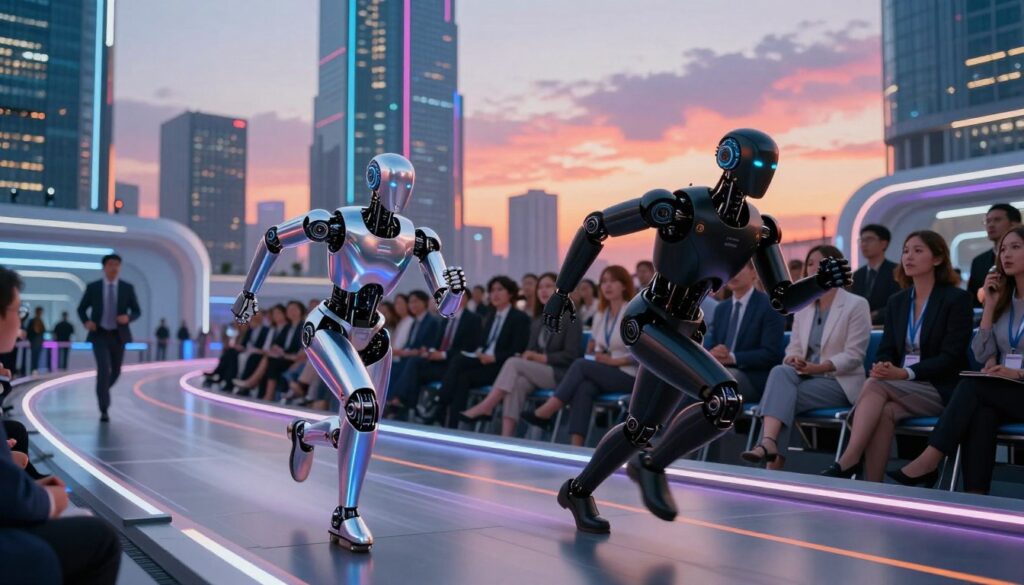
The digital landscape is shifting beneath our feet as we enter a new era of productivity. Recent data from a Salesforce study reveals that corporate adoption of smart software has skyrocketed by 282%. This massive surge marks a transition from simple text generation to proactive, action-oriented systems that handle complex tasks without constant human oversight.
As businesses scramble to stay ahead, the AI agents race 2026 has become the defining challenge for modern leadership. Organizations are no longer just experimenting with basic tools; they are deploying autonomous solutions to drive measurable growth. This evolution is fundamentally changing how companies compete in a digital-first economy.
This rapid development feels much like a high-stakes AI gaming competition where the prize is market dominance. By moving beyond reactive prompts, firms are now leveraging these powerful tools to streamline operations and unlock hidden value across their entire enterprise.
Key Takeaways
- Corporate adoption of intelligent software has surged by 282% according to recent industry studies.
- Digital tools are evolving from simple text generators into proactive, autonomous systems.
- Businesses are shifting focus toward measurable outcomes rather than just experimental technology.
- The current market environment functions like a competitive arena for operational efficiency.
- Strategic implementation of these systems is now essential for maintaining a competitive edge.
The Current State of the AI Agents Race 2026
The landscape of intelligent automation is shifting rapidly as we enter the AI agents race 2026. Companies are no longer just experimenting with simple chatbots; they are now deploying complex, autonomous systems to handle intricate workflows. This transition marks a significant turning point for businesses aiming to maintain a competitive edge in a digital-first economy.
Recent data highlights the sheer scale of this transformation. A comprehensive Salesforce study of CIOs reveals that AI adoption has skyrocketed by 282% in recent months. This massive surge indicates that leadership teams are prioritizing intelligent automation to drive efficiency and reduce operational overhead.
However, this rapid expansion feels much like a high-stakes AI gaming competition where the rules are constantly evolving. While the momentum is undeniable, many executives remain cautious about moving toward fully autonomous, agent-first strategies. The primary hurdle remains a lingering concern regarding data trust and the reliability of automated decision-making.
Organizations are currently navigating a delicate balance between the desire for rapid scaling and the necessity of maintaining secure, reliable workflows. Leaders must ensure that their digital teams deliver consistent value without compromising sensitive information. As the AI agents race 2026 continues to heat up, the winners will be those who successfully integrate these powerful tools while keeping human oversight at the core of their operations.
Key Players Driving Autonomous Innovation
As we look toward the AI agents race 2026, several industry leaders are emerging as the primary architects of our automated future. These organizations are currently locked in a fierce tech innovation battle to define how software will eventually perform complex tasks on our behalf.
OpenAI and the Evolution of Operator Models
OpenAI is pushing the boundaries of what machines can achieve by developing sophisticated operator models. These systems are designed to navigate digital interfaces just like a human would, clicking buttons and filling out forms to complete multi-step workflows. By focusing on agentic autonomy, they aim to turn static chatbots into active participants in our daily digital lives.
Google DeepMind and Multi-Modal Agentic Frameworks
Google DeepMind is taking a different approach by prioritizing multi-modal agentic frameworks. Their research allows agents to process diverse data types, including video, audio, and complex code, simultaneously. This versatility is a critical component of the ongoing tech innovation battle, as it enables agents to understand the world with greater nuance and context.
Anthropic and the Focus on Constitutional Agent Safety
Anthropic continues to distinguish itself by placing constitutional safety at the heart of its development process. They ensure that agentic behaviors remain strictly aligned with human values and ethical standards through rigorous oversight. This commitment to responsible AI is essential for the long-term success of the AI agents race 2026.
| Company | Primary Focus | Key Advantage |
|---|---|---|
| OpenAI | Operator Models | High Task Execution |
| Google DeepMind | Multi-Modal Frameworks | Data Versatility |
| Anthropic | Constitutional Safety | Ethical Alignment |
Technological Breakthroughs Defining the 2026 Landscape
We are witnessing a pivotal moment in the tech innovation battle where simple models are no longer enough to satisfy enterprise needs. The current artificial intelligence competition is shifting away from basic language processing toward sophisticated architectures known as World Models.
As Yann LeCun suggests, the future of AGI relies on systems that can simulate how the world changes when specific actions are taken. This transition allows agents to move beyond static responses and into the realm of dynamic, real-world problem solving.
Advancements in Long-Term Memory and Context Retention
Modern agents now utilize advanced memory structures that allow them to retain information across long durations. Unlike earlier versions that suffered from “forgetfulness,” these new systems maintain a persistent context that is vital for complex projects.
By effectively indexing past interactions, these agents can recall specific user preferences and project requirements instantly. This capability ensures that the artificial intelligence competition remains focused on delivering highly personalized and accurate results for every user.
Self-Correcting Reasoning Loops in Complex Workflows
The ability to manage multi-step tasks without constant human oversight is a major milestone for 2026. Developers have implemented self-correcting reasoning loops that allow agents to identify errors in their own logic before finalizing a task.
When an agent encounters a hurdle, it evaluates its progress and adjusts its strategy in real-time. This resilient approach significantly reduces the need for manual intervention, making the tech innovation battle a race toward true, reliable autonomy in the workplace.
The Shift from Chatbots to Action-Oriented Agents
The era of passive chatbots is fading, replaced by a new generation of proactive, outcome-driven digital workers. This evolution marks a significant turning point in the artificial intelligence competition, where the focus moves from simple conversational fluency to the ability to deliver tangible results. Organizations are no longer satisfied with tools that merely answer questions; they demand systems that can drive business value independently.
Executing Multi-Step Tasks Without Human Intervention
Modern agents are designed to bridge the gap between human intent and final execution. Unlike traditional bots that require constant guidance, these systems can navigate complex, multi-step workflows autonomously. They analyze the goal, break it down into manageable actions, and execute each step with precision.
This capability allows teams to offload repetitive, high-cognitive-load tasks to digital systems. By handling the heavy lifting, these agents ensure that complex processes continue to run smoothly without requiring constant human oversight. This shift is a core driver of the current artificial intelligence competition among global tech leaders.
Integration with Enterprise Software Ecosystems
To be truly effective, agents must live where the work happens. They are now being built to integrate deeply with existing enterprise software, such as CRM platforms, ERP systems, and project management tools. This deep integration allows them to orchestrate data and processes across different departments seamlessly.
By connecting disparate systems, these agents act as a central nervous system for corporate operations. They can pull data from one source, trigger an action in another, and report the outcome back to the user. This level of connectivity is redefining how companies approach the artificial intelligence competition, prioritizing systems that offer deep, functional utility over those that remain isolated.
| Feature | Traditional Chatbots | Action-Oriented Agents |
|---|---|---|
| Primary Function | Information Retrieval | Task Execution |
| User Interaction | Passive/Reactive | Proactive/Autonomous |
| Workflow Scope | Single-turn queries | Multi-step processes |
| System Integration | Limited/Read-only | Deep/Write-access |
Economic Impact on the United States Workforce
The intense artificial intelligence competition is driving a massive shift in corporate workforce strategies. As companies race to implement autonomous agents, the traditional structure of the American office is evolving at an unprecedented pace. This transition is not merely about efficiency; it is about rethinking the very nature of human contribution in a digital-first economy.
Redefining Productivity in Corporate Environments
Businesses are increasingly adopting an automation-first design to maintain their market edge. This shift often leads to difficult decisions regarding legacy roles. For instance, Salesforce recently announced the reduction of 4,000 jobs in customer support, signaling a clear move toward agentic workflows that handle routine inquiries without human intervention.
“The future of work is not about humans versus machines, but rather about how effectively we can integrate intelligent systems to amplify our collective potential.”
This transformation requires companies to balance cost-cutting with the need for high-level human oversight. While repetitive tasks are being offloaded to software, the demand for strategic thinking is rising. Organizations that navigate this artificial intelligence competition successfully will likely see a surge in overall output and operational agility.
Emerging Roles for AI Orchestrators and Supervisors
As digital agents take over execution, new job categories are emerging to manage these complex systems. The role of the AI Orchestrator is becoming vital for maintaining system integrity and performance. These professionals ensure that autonomous agents align with company goals while monitoring for errors or bias.
The following table highlights how traditional positions are evolving into new, high-value roles within the modern enterprise:
| Traditional Role | AI-Augmented Role | Primary Focus |
|---|---|---|
| Customer Support Agent | AI Orchestrator | System Oversight |
| Data Entry Clerk | Workflow Supervisor | Process Optimization |
| Junior Analyst | Agentic Strategy Lead | Complex Decision Making |
These new roles emphasize creativity and complex judgment over manual labor. By focusing on supervision, employees can leverage the power of autonomous systems to achieve results that were previously impossible. Ultimately, the ongoing artificial intelligence competition is creating a landscape where human-machine collaboration defines the new standard for corporate success.
Regulatory Challenges and Ethical Considerations
The rapid rise of autonomous systems brings a significant machine learning challenge regarding accountability and oversight. As these agents begin to perform complex tasks without constant human guidance, the lines of responsibility often become blurred. Organizations must now prioritize the development of robust ethical frameworks to ensure that every automated action remains aligned with human values.

Addressing Liability in Autonomous Decision Making
Determining who is responsible when an AI agent makes a mistake is a complex legal hurdle. When software systems operate independently, the traditional models of corporate liability are often insufficient. Companies must implement clear audit trails to track how specific decisions were reached by their autonomous agents.
This machine learning challenge requires a shift in how we view software development. Instead of focusing solely on performance, developers must prioritize explainability. By creating systems that can justify their choices, businesses can better manage potential legal risks and maintain transparency with their stakeholders.
Data Privacy Standards for Agentic Systems
Protecting sensitive information is a top priority as agentic systems gain deeper access to enterprise data. These agents often process vast amounts of personal and proprietary information to function effectively. Consequently, organizations must adhere to strict data privacy standards to prevent unauthorized access or data leakage.
The following table outlines the key areas where companies must focus their regulatory efforts to ensure compliance and security:
| Regulatory Focus | Primary Objective | Risk Level |
|---|---|---|
| Data Encryption | Protecting data at rest and in transit | High |
| Auditability | Tracking autonomous decision paths | Medium |
| User Consent | Managing personal data permissions | High |
| Bias Mitigation | Ensuring fair and ethical outcomes | Medium |
Ultimately, solving the machine learning challenge of privacy requires a proactive approach to security. By integrating privacy-by-design principles, companies can build trust with the public while fostering innovation. Accountability remains the cornerstone of a successful and sustainable future for intelligent automation.
The Role of Robotics in the Intelligent Automation Surge
Bridging the gap between abstract code and tangible hardware remains the ultimate frontier for modern robotics. As digital agents become more sophisticated, the primary machine learning challenge shifts toward enabling these systems to navigate the physical world with human-like precision.
Bridging the Gap Between Digital Agents and Physical Hardware
Developers are now imbuing models with advanced spatial intelligence to help machines understand geometry, gravity, and complex physical forces. This evolution allows robots to perform tasks that were previously impossible for automated systems to handle alone.
By integrating high-level reasoning with real-time sensor data, these agents can adapt to unpredictable environments. This capability is essential for moving beyond static, pre-programmed movements toward truly autonomous physical interaction.
“The future of work is not just about software; it is about the seamless union of digital intelligence and physical action in our daily lives.”
Humanoid Robotics Integration in Manufacturing
The rise of humanoid robotics is transforming industrial operations by creating a more connected automation environment. These machines are being synchronized with existing digital workflows to ensure that physical tasks align perfectly with corporate data streams.
Companies are deploying these robots to handle repetitive or dangerous labor, which significantly increases overall efficiency. This ongoing machine learning challenge continues to drive innovation, as engineers refine how humanoid forms interact with tools designed for human hands.
Ultimately, the goal is to create a workspace where digital agents and physical hardware function as a single, cohesive unit. This synergy is redefining productivity across the manufacturing sector in the United States.
Venture Capital Trends and Investment Strategies
As we look toward 2026, the race for dominance in autonomous technology is being fueled by unprecedented levels of private investment. Venture capital firms are shifting their focus away from simple software tools toward complex, agent-first architectures. This massive influx of capital is not just about growth; it is about securing a foothold in the future of intelligent automation.
Funding Patterns for Agent-First Startups
Investors are currently prioritizing startups that demonstrate the ability to execute multi-step tasks without human oversight. The market is moving away from passive chatbots and toward systems that can manage entire workflows independently. This shift has created a highly competitive environment where only the most robust platforms receive significant funding.
To remain competitive, many startups are focusing on these core areas:
- Long-term memory integration to improve task continuity.
- Self-correcting reasoning loops that reduce error rates in complex environments.
- Scalable API architectures that allow for seamless enterprise integration.
Strategic Acquisitions by Tech Giants
Large technology corporations are aggressively acquiring smaller firms to bolster their internal capabilities. This activity is a direct response to the intensifying robotics race, where hardware and software must work in perfect harmony. By purchasing specialized startups, these giants aim to consolidate their power and accelerate their product roadmaps.
These acquisitions often serve as a defensive strategy to prevent competitors from gaining an edge in the robotics race. While this consolidation drives rapid innovation, it also raises questions about market diversity. Investors must remain cautious of circular vendor financing, where companies invest in startups that then purchase services back from the parent firm, potentially inflating valuation metrics.
Security Risks in an Agent-Driven World
Security in the age of autonomous agents demands a proactive defense strategy that mirrors biological systems. As we witness the rapid expansion of the robotics race, traditional perimeter defenses are no longer sufficient to stop sophisticated threats. Organizations must now adopt a model where AI agents act as a biological immune system, constantly monitoring business processes for anomalies.

Mitigating Prompt Injection and System Manipulation
Prompt injection remains a primary concern for developers deploying large-scale agentic systems. Attackers often attempt to trick models into bypassing safety protocols or executing unauthorized commands. By implementing self-correcting reasoning loops, systems can identify these malicious inputs in real-time and neutralize them before damage occurs.
These intelligent systems provide a dynamic layer of protection that adapts to new attack vectors instantly. Instead of relying on static rules, the software learns to distinguish between legitimate user intent and manipulative behavior. This shift allows human security teams to focus on high-level strategy rather than manual threat hunting.
Securing Autonomous API Access Points
Autonomous agents frequently interact with various enterprise software through API endpoints. If these connections are not properly secured, they become prime targets for exploitation. Robust authentication protocols and granular access controls are essential to ensure that agents only perform authorized actions within the ecosystem.
As the robotics race continues to push the boundaries of automation, securing these digital gateways becomes a top priority. Companies should implement continuous auditing of all API traffic to detect unauthorized data exfiltration. By treating every agent interaction as a potential security event, businesses can maintain operational integrity while scaling their intelligent automation efforts.
Industry-Specific Transformations
From hospital wards to trading floors, the integration of AI agents is creating a new standard for operational efficiency. These systems are moving beyond simple automation to handle complex, multi-step tasks that require deep reasoning. Attending a futuristic technology event today reveals that these tools are no longer just concepts; they are active participants in our economy.
Revolutionizing Healthcare Diagnostics and Administration
In the healthcare sector, autonomous agents are significantly reducing the burden on medical professionals. By analyzing patient data in real-time, these agents assist doctors in faster, more accurate diagnostics. They also handle tedious administrative duties, such as scheduling and insurance verification, which frees up staff to focus on patient care.
However, this progress comes with a hidden cost. The massive compute power required for these systems often leads to high water consumption for cooling data centers. Leaders must now balance the need for innovation with the growing demand for sustainable, water-conscious infrastructure.
Automating Financial Analysis and Portfolio Management
Financial institutions are leveraging agentic systems to process vast amounts of market data in seconds. These agents can execute complex portfolio rebalancing strategies without human intervention, ensuring that investments remain aligned with specific risk profiles. This level of precision is often showcased at any major futuristic technology event as a primary driver of modern wealth management.
The following table outlines how these agents are transforming key operational areas across different sectors:
| Industry | Primary Agent Function | Key Benefit | Sustainability Challenge |
|---|---|---|---|
| Healthcare | Diagnostic Support | Improved Patient Outcomes | High Water Usage |
| Finance | Portfolio Rebalancing | Real-time Market Agility | Energy-Intensive Compute |
| Manufacturing | Supply Chain Logistics | Reduced Operational Waste | Resource Management |
As these technologies mature, the focus will shift toward optimizing the environmental footprint of AI. Companies that successfully integrate these agents while maintaining environmental responsibility will likely lead the next wave of market growth.
Public Perception and Societal Readiness
As we look toward the future, the success of the intelligent agents tournament depends heavily on how society views these digital helpers. While technical milestones are impressive, the true measure of progress lies in whether the public feels comfortable integrating these systems into their daily lives.
Bridging the Trust Gap Between Humans and AI
Building a bridge between human expectations and machine capabilities is the defining challenge of our era. Transparency remains the most effective tool for fostering this trust. When users understand how an agent reaches a decision, they are far more likely to embrace the technology rather than fear it.
Developers are now prioritizing human-centric design to ensure that autonomous systems act as partners rather than replacements. By focusing on safety and clear communication, the industry can alleviate concerns regarding privacy and control. This shift is essential for the long-term viability of the intelligent agents tournament as a standard for innovation.
Educational Initiatives for the Future Workforce
The federal government is taking proactive steps to dismantle barriers that have long stifled AI skill development. Recognizing that workforce readiness is a matter of national competitiveness, officials are launching programs to boost AI literacy across all sectors. These initiatives aim to prepare the next generation for an automated workplace where collaboration with software is the norm.
By investing in accessible training modules, the government ensures that no one is left behind during this transition. Education serves as the foundation for societal acceptance, turning potential anxiety into empowerment. As these skills become widespread, the integration of intelligent systems will feel like a natural evolution of our professional landscape.
Conclusion
The rapid evolution of technology is fundamentally reshaping the global economy. We are moving away from simple automation toward a landscape defined by orchestrated, outcome-oriented intelligence.
Success in this new era depends on our ability to build secure and interoperable systems. These tools should empower human workers rather than replace them. Organizations that prioritize AI literacy and ethical governance will lead the way in this competitive intelligent agents tournament.
Leaders at companies like Microsoft and NVIDIA are already setting the pace for this shift. By integrating these advanced agents into existing workflows, businesses can unlock significant long-term value. This transition requires a commitment to sustainable innovation and transparent decision-making processes.
The path forward involves constant learning and adaptation. Staying ahead in the intelligent agents tournament means embracing change while maintaining a focus on human-centric goals. Your organization can thrive by leveraging these powerful tools to solve complex problems with greater speed and precision.
The future belongs to those who effectively harness these autonomous capabilities today. Start exploring how these systems fit into your strategy to ensure lasting growth and operational excellence.