

Gone are the days of relying on hunches to connect with customers. Today’s fast-paced market demands smarter tools. Enter artificial intelligence, a force reshaping how brands interact with audiences. By 2028, the AI marketing sector is projected to skyrocket from $15.84 billion to $107.5 billion. Why? Because guessing games no longer cut it.
Modern strategies thrive on patterns hidden in data. Advanced algorithms analyze real-time information to spot trends, optimize ad budgets, and refine targeting. This approach lets businesses anticipate needs instead of reacting to them. Imagine knowing what a customer wants before they do—that’s the power of predictive analytics.
Traditional methods struggle to keep up with shifting consumer behaviors. Static campaigns often miss the mark, wasting resources. In contrast, AI-driven systems adapt dynamically. They process billions of data points to suggest optimal timing, channels, and messages. The result? Higher engagement and better returns.
This guide unpacks the tools and techniques behind these innovations. You’ll see how forward-thinking brands leverage technology to stay ahead. From audience segmentation to budget allocation, every decision becomes sharper with data-backed insights.
Key Takeaways
- The AI marketing industry is growing rapidly, expected to reach $107.5 billion by 2028.
- Data-driven strategies replace guesswork, boosting campaign accuracy and efficiency.
- Predictive models analyze real-time information to identify trends and opportunities.
- Anticipating consumer behavior leads to more personalized and timely interactions.
- Traditional marketing approaches are losing ground to adaptive, AI-powered solutions.
Understanding Predictive Analytics and AI in Digital Marketing
Today’s marketers don’t wait for trends—they spot them as they form. At its core, this approach combines historical patterns with real-time signals to shape strategies. Think of it as a crystal ball powered by numbers, not magic.
Fundamentals and Key Concepts
Three pillars drive these systems:
- Data collection: Every click, search, and purchase feeds the machine
- Pattern recognition: Algorithms detect hidden connections in behavior
- Automated decisions: Systems adjust campaigns without human delays
Machine learning transforms raw numbers into actionable insights. For example, natural language processing deciphers social media sentiment, while predictive modeling forecasts which leads will convert. This isn’t fortune-telling—it’s mathematics in motion.
The Role of AI in Campaign Success
Here’s where technology shines: analyzing 10,000 ad variations in seconds or personalizing emails for millions. Human teams simply can’t match that scale. One retail brand saw 37% higher click-through rates after letting algorithms optimize their creatives.
The real advantage? Constant improvement. These tools learn from every interaction, refining their predictions like a chef perfecting a recipe. That’s why early adopters gain such fierce competitive edges.
The Importance of Data Quality for Effective Analytics
Imagine building a house on sand versus solid rock—data quality determines which foundation your analytics stand on. Reliable information transforms vague assumptions into precise strategies. One flawed dataset can skew results, leading to misguided decisions that drain budgets.
“Think of data quality as the fuel that powers your analytics engine—low-grade inputs guarantee sputtering outcomes.”
Leveraging 1st-Party, 3rd-Party, and Historical Data
First-party data acts as your truth north. Collected from website visits, purchase histories, and app interactions, it reflects real customer behavior. This goldmine reveals:
- Preferred products
- Browsing patterns
- Response to promotions
Third-party sources add context—like demographic details—but require scrutiny. Nearly 43% of marketers report integration headaches when blending external datasets. Always verify sources through:
- Cross-referencing with known benchmarks
- Checking collection methods
- Testing accuracy against live campaigns
Historical records shine light on seasonal trends and campaign performance. Analyzing past engagement rates helps predict future peaks. For instance, a clothing brand might discover swimwear searches spike 18 days earlier than actual purchases—critical timing for ad launches.
Freshness matters too. Data older than 90 days often misleads more than it guides. Establish routines to purge outdated entries and refresh customer profiles monthly. This maintenance keeps your models sharp and predictions actionable.
Leveraging Machine Learning for Campaign Optimization
Every millisecond counts when budgets are on the line. Modern advertising platforms now deploy self-improving systems that adapt faster than any human team. These tools don’t just follow rules—they rewrite them based on live results.

Real-Time Decision Making and Bid Adjustments
Picture a stock exchange floor for ads. When an impression becomes available, algorithms evaluate:
- User’s recent browsing history
- Device type and location
- Competitor bid patterns
This happens in under 100 milliseconds—faster than a hummingbird flaps its wings. One travel company reduced cost-per-booking by 22% using these instant calculations.
Enhancing Ad Targeting with ML Models
Traditional targeting guesses interests. Smart systems prove them. A fitness brand discovered gym enthusiasts through yoga mat purchases and morning jog search patterns. Their click-through rates jumped 41% after refining segments.
These models grow sharper with each interaction. They test creatives, adjust delivery times, and even pause underperforming ads autonomously. The result? Less guesswork, more measurable outcomes.
how to use predictive analytics AI in digital marketing campaigns
Nearly 3 in 5 marketing teams now harness smart technology to refine their approaches. With 74% of U.S. professionals adopting these solutions, the path from planning to execution has never been clearer.
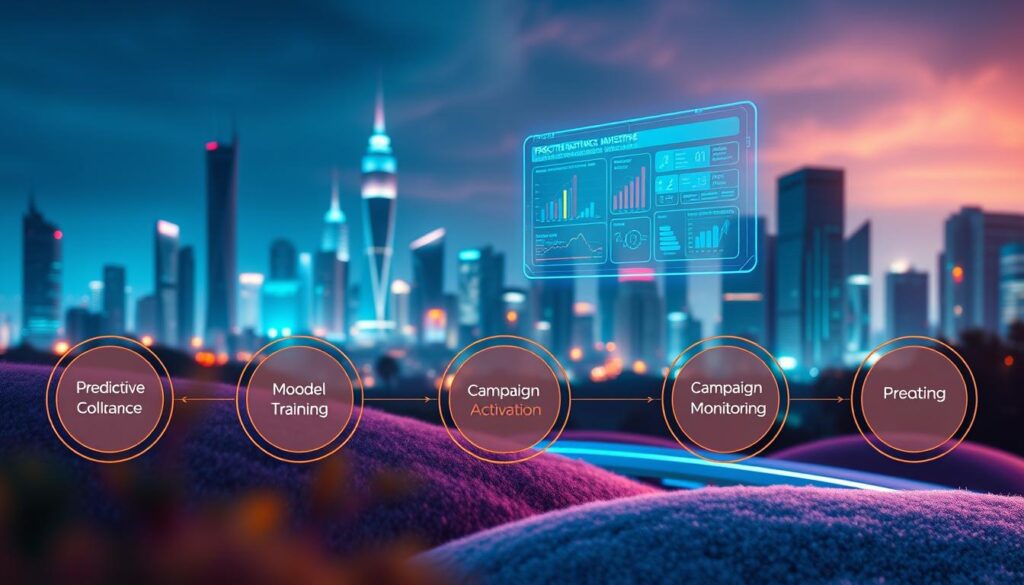
Step-by-Step Implementation Guide
Begin by auditing existing information streams. Assess what data you collect, where gaps exist, and which metrics matter most. Over 66% of teams find this initial review crucial for aligning tech choices with organizational goals.
Three core phases drive successful adoption:
- Tool selection: Match platform capabilities to budget and team size
- Integration: Connect new systems with current workflows
- Validation: Test predictions against historical outcomes
Best Practices for Dynamic Campaign Management
Set clear performance benchmarks before launch. Establish thresholds for automatic adjustments—like pausing underperforming ads when click costs exceed targets. Over half of content-focused teams use similar rules to maintain quality.
Regularly refresh training data to keep models accurate. One e-commerce brand improved conversion forecasts by 29% through weekly data updates. Pair this with quarterly system audits to ensure continued alignment with market shifts.
Build cross-functional review teams. Blend data scientists with creative staff to balance technical insights with brand voice considerations. This fusion helps 47% of research-driven organizations maintain authenticity while scaling automated efforts.
Integrating AI Tools into Your Marketing Strategy
Selecting the right tech stack separates leaders from followers in modern marketing. With 88% of professionals using ChatGPT and competitors like Google Gemini (52%) and Microsoft Copilot (44%) gaining ground, building a versatile toolkit matters more than chasing a single “perfect” solution.
Evaluating Platforms and Tools
Start by mapping your team’s capabilities to platform requirements. Key considerations include:
- Integration depth: Can new systems communicate with your CRM or email software?
- Scalability: Will pricing models strain budgets as campaigns expand?
- Support quality: One study found 68% of teams prioritize vendors offering 24/7 technical assistance
Most successful teams combine specialized tools rather than relying on one platform. Research shows 71% use multiple solutions—the average marketer juggles 2-3 systems. A social media manager might pair ChatGPT for content ideas with separate analytics platforms for performance tracking.
Security can’t be an afterthought. Verify compliance with regulations like GDPR and CCPA before implementation. Regular audits help maintain trust while protecting customer data from emerging threats.
“Think of your tech stack as a sports team—each player has unique strengths that combine to win games.”
Prioritize tools addressing immediate needs first. A small business might focus on chatbots to handle customer inquiries, while enterprise teams could invest in predictive budget allocation systems. Whatever your choice, ensure it adapts as your strategy evolves.
Enhancing Customer Engagement Through Predictive Models
Customers now expect interactions that feel made just for them. Smart technology bridges this gap by transforming raw data into tailored journeys. Platforms analyze browsing habits, purchase histories, and even device preferences to craft experiences that resonate.
Personalized Advertising Strategies
Netflix’s thumbnail customization offers a masterclass in relevance. Fans of romantic comedies see cozy scenes, while action enthusiasts get explosions—all for the same film. This approach boosted their click-through rates by 35% in early tests.
Dynamic content adapts in real-time based on visitor behavior. A travel site might display tropical getaways to users researching beaches, while showing ski deals to those searching winter gear. Location data further refines offers—local events pop up for nearby customers.
Timing matters as much as messaging. Algorithms pinpoint when specific audience segments check emails or scroll social feeds. One retailer increased open rates by 28% by sending promotions during lunch breaks for office workers.
Over 60% of marketers report higher engagement when using behavior-based personalization. These systems also predict churn risks, allowing teams to retain at-risk consumers with targeted incentives before they disengage.
“The best experiences don’t feel automated—they feel like serendipity.”
Maximizing ROI with AI-Driven Campaign Adjustments
The secret to marketing efficiency lies in letting data guide every dollar spent. Three-quarters of businesses now see measurable returns from smart systems, with a third calling results “game-changing.” This shift turns budgets from fixed plans into living strategies that evolve with audience behavior.
Automated Budget Allocation and Performance Tracking
Modern tools act like financial navigators for ad spend. They analyze which channels drive purchases versus those draining resources. When social media engagement spikes for a product line, funds flow there instantly—no waiting for human approval.
These systems compare performance across platforms 24/7. One retailer boosted sales by 19% after letting algorithms redistribute budgets hourly. Underperforming ads get paused automatically, freeing cash for better opportunities.
Key advantages emerge:
- Real-time ROI calculations prevent wasted spend
- Historical patterns inform future allocations
- Cross-channel effectiveness becomes measurable
Teams gain clarity while machines handle number crunching. The result? Leaner budgets, fatter returns, and campaigns that improve themselves.