
The artificial intelligence revolution is reshaping our workforce at an unprecedented pace. While some traditional roles may evolve, exciting new careers are emerging that combine human creativity with AI capabilities. These aren’t just jobs of the future—they’re rapidly growing opportunities that organizations are actively hiring for today. In this guide, we’ll explore seven high-growth AI careers that will flourish by 2026, offering both job security and the chance to shape how AI transforms our world.
How AI Is Transforming the Job Market
Artificial intelligence is no longer just a buzzword—it’s becoming integrated into virtually every industry. According to recent projections, the global AI market is expected to grow exponentially, creating millions of new jobs across sectors. While automation may change some traditional roles, the demand for professionals who can work with, manage, and enhance AI systems is skyrocketing.
What makes these emerging AI careers particularly exciting is that many don’t require deep technical expertise in machine learning algorithms or neural networks. Instead, they leverage uniquely human skills—creativity, ethical judgment, strategic thinking, and interpersonal communication—combined with an understanding of AI capabilities.
Let’s explore the seven AI-focused careers that will see tremendous growth by 2026, what these roles involve, and why they’ll be in high demand.
1. AI Automation and Workflow Specialists

What They Do
AI automation specialists identify processes within organizations that can benefit from AI-powered automation. They analyze existing workflows, design improved systems that incorporate artificial intelligence, and implement solutions that boost efficiency while reducing costs.
These professionals serve as bridges between business operations and technology teams. They understand both the practical needs of different departments and how AI tools can address those needs. Their expertise spans process mapping, change management, and AI implementation.
Why This Role Will Grow
As organizations across industries seek to streamline operations and reduce costs, the demand for specialists who can identify automation opportunities and implement AI solutions will surge. These professionals deliver measurable ROI by eliminating repetitive tasks, reducing errors, and freeing human workers to focus on higher-value activities.
Develop Automation Skills 🚀
Start building expertise in process optimization and AI automation tools with specialized courses.
2. AI Prompt and Workflow Designers

What They Do
Prompt designers are the architects of AI interactions. They craft the instructions that guide AI systems to produce desired outputs, whether that’s generating content, analyzing data, or solving problems. These professionals understand how to structure prompts that elicit accurate, useful, and contextually appropriate responses from AI models.
Beyond individual prompts, these specialists design entire AI workflows—sequences of prompts and operations that accomplish complex tasks. They create templates and systems that non-technical users can leverage to get consistent results from AI tools.
Why This Role Will Grow
As generative AI becomes more prevalent in business operations, the ability to effectively “speak AI’s language” becomes increasingly valuable. Organizations need specialists who can design prompts and workflows that maximize AI capabilities while avoiding common pitfalls like hallucinations or biased outputs.
Master Prompt Engineering 🚀
Learn the art and science of crafting effective AI prompts with expert-led training.
3. AI Content Strategists and Supervisors

What They Do
AI content strategists develop frameworks for how organizations use AI in content creation. They establish guidelines for when to use AI, how to maintain brand voice, and what review processes ensure quality. These professionals don’t just use AI tools—they shape how entire teams leverage artificial intelligence for content production.
Content supervisors oversee AI-generated outputs, providing the human judgment needed to evaluate quality, accuracy, and appropriateness. They edit and refine AI-created content while training the systems to better align with organizational needs over time.
Why This Role Will Grow
As AI content generation becomes mainstream, organizations need experts who can develop strategic approaches to integrating these tools into content workflows. The human element remains crucial—AI content strategists ensure that technology enhances rather than replaces human creativity while maintaining quality standards.
Enhance Content Strategy Skills 🚀
Develop expertise in AI-powered content creation and management strategies.
4. AI Ethics and Compliance Advisors

What They Do
AI ethics advisors help organizations navigate the complex ethical considerations of artificial intelligence implementation. They assess AI systems for potential biases, privacy concerns, and unintended consequences. These professionals develop frameworks for responsible AI use and ensure compliance with emerging regulations.
Beyond identifying problems, ethics advisors collaborate with development teams to implement solutions—adjusting data sets, modifying algorithms, or creating oversight processes that mitigate risks while preserving AI benefits.
Why This Role Will Grow
As AI becomes more powerful and widespread, ethical considerations move from theoretical to practical concerns. Organizations face increasing regulatory scrutiny and public expectations around responsible AI use. Ethics advisors help companies avoid reputational damage, legal issues, and harmful outcomes from AI systems.
Develop AI Ethics Expertise 🚀
Build knowledge in responsible AI practices and ethical frameworks.
5. AI Product Managers and Data Analysts

What They Do
AI product managers oversee the development and implementation of AI-powered products and features. They translate business needs into technical requirements, prioritize development efforts, and ensure AI solutions deliver real value. These professionals coordinate cross-functional teams including data scientists, engineers, and business stakeholders.
Data analysts working in AI contexts help organizations extract actionable insights from complex data sets. They prepare data for AI systems, evaluate model performance, and communicate findings to non-technical audiences. Their work ensures that AI tools have the quality inputs needed for accurate outputs.
Why This Role Will Grow
As AI becomes central to product development across industries, the need for specialized product managers who understand both business strategy and AI capabilities will increase dramatically. Organizations need professionals who can guide AI projects from concept to launch while ensuring alignment with business goals.
Build AI Product Management Skills 🚀
Develop expertise in managing AI product development and implementation.
6. AI Educators and Trainers

What They Do
AI educators develop and deliver training programs that help professionals across organizations effectively use artificial intelligence tools. They create learning materials, conduct workshops, and provide ongoing support as teams adopt new AI-powered workflows.
These specialists translate complex technical concepts into accessible language for non-technical users. They focus not just on tool functionality but on helping employees understand how AI can enhance their specific roles and solve real business problems.
Why This Role Will Grow
As AI tools become standard across workplaces, organizations face a critical skills gap. AI educators bridge this gap by empowering employees at all levels to confidently use these new technologies. Their work accelerates adoption, reduces resistance to change, and maximizes return on AI investments.
Develop AI Training Skills 🚀
Learn how to effectively teach AI concepts and tools to diverse audiences.
7. AI Security and Privacy Specialists

What They Do
AI security specialists protect artificial intelligence systems from threats while ensuring they handle data responsibly. They identify vulnerabilities in AI models, implement safeguards against attacks like data poisoning or prompt injection, and develop protocols for secure AI operations.
Privacy specialists focus specifically on how AI systems collect, process, and store sensitive information. They ensure compliance with data protection regulations, implement privacy-by-design principles, and develop governance frameworks for responsible data use.
Why This Role Will Grow
As AI systems handle increasingly sensitive data and make more consequential decisions, securing these systems becomes mission-critical. Organizations need specialists who understand both traditional cybersecurity and the unique vulnerabilities of artificial intelligence models. With growing regulatory requirements around data privacy, this expertise becomes even more valuable.
Build AI Security Expertise 🚀
Develop specialized knowledge in protecting AI systems and ensuring data privacy.
Essential Skills for Future AI Careers
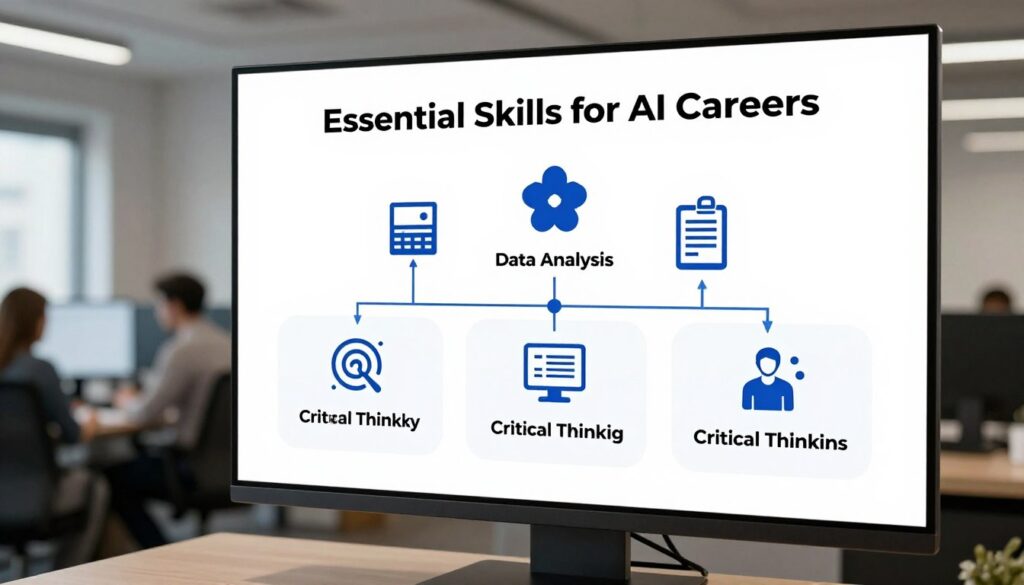
Technical Skills
- Basic understanding of AI/ML concepts
- Data literacy and analysis
- Familiarity with AI tools and platforms
- Process mapping and workflow design
- Basic programming (Python recommended)
Soft Skills
- Critical thinking and problem-solving
- Effective communication across technical levels
- Adaptability and continuous learning
- Ethical reasoning and judgment
- Creativity and strategic thinking
The most successful AI professionals combine technical knowledge with strong interpersonal and critical thinking abilities. While deep technical expertise is valuable for some roles, many emerging AI careers prioritize your ability to bridge the gap between technology and business needs.
How to Prepare for These AI Careers

1. Build Foundational Knowledge
Start with courses that provide a broad understanding of artificial intelligence concepts, capabilities, and limitations. You don’t need to become a data scientist, but understanding how AI works will help you collaborate effectively with technical teams.
2. Develop Specialized Skills
Based on your career interests, focus on developing relevant specialized skills. For example, if you’re interested in AI ethics, study both ethical frameworks and how they apply to technology. If prompt design interests you, practice creating effective prompts for various AI systems.
3. Gain Practical Experience
Look for opportunities to apply AI tools in your current role or through side projects. Practical experience using AI systems will give you insights that theoretical knowledge alone cannot provide. Document your projects to build a portfolio demonstrating your capabilities.
4. Stay Current with AI Developments
The artificial intelligence field evolves rapidly. Follow industry publications, join AI communities, and participate in webinars to stay informed about new tools, techniques, and best practices. This ongoing learning will be essential throughout your AI career.
5. Network with AI Professionals
Connect with people already working in AI roles through professional organizations, online communities, and industry events. These connections can provide mentorship, job leads, and insights into how different organizations are implementing AI.
Launch Your AI Career Journey Today

The artificial intelligence revolution is creating unprecedented opportunities for professionals who can bridge the gap between powerful AI technologies and real-world applications. These emerging careers offer not just job security but the chance to shape how AI transforms industries and society.
What makes these roles particularly exciting is their accessibility—you don’t need a PhD in computer science to thrive in many of these careers. By building a foundation of AI knowledge and leveraging your existing expertise, you can position yourself for success in this rapidly growing field.
The time to prepare is now. As organizations across industries accelerate their AI adoption, the demand for professionals who can implement, manage, and optimize these technologies will only increase. By taking proactive steps today, you’ll be ready to seize these opportunities as they emerge.
Launch Your AI Career 🚀
Start building the skills you need for high-growth AI careers with comprehensive online learning.
Frequently Asked Questions
Do I need a technical background to pursue these AI careers?
While some technical understanding is helpful, many emerging AI roles prioritize domain expertise, critical thinking, and communication skills over deep technical knowledge. Roles like AI ethics advisor, content strategist, or educator often value your industry experience combined with AI literacy rather than programming expertise.
How quickly can I transition into an AI-focused role?
The timeline varies based on your current skills and target role. Many professionals can begin incorporating AI aspects into their existing positions within 3-6 months of focused learning. Complete career transitions typically take 6-18 months of dedicated preparation, including coursework and practical experience.
Which industries will have the highest demand for these AI roles?
Healthcare, financial services, retail, manufacturing, and professional services are expected to lead in AI adoption and job creation. However, these roles will be needed across virtually all sectors as artificial intelligence becomes a standard business tool rather than a specialized technology.






Comments are closed