
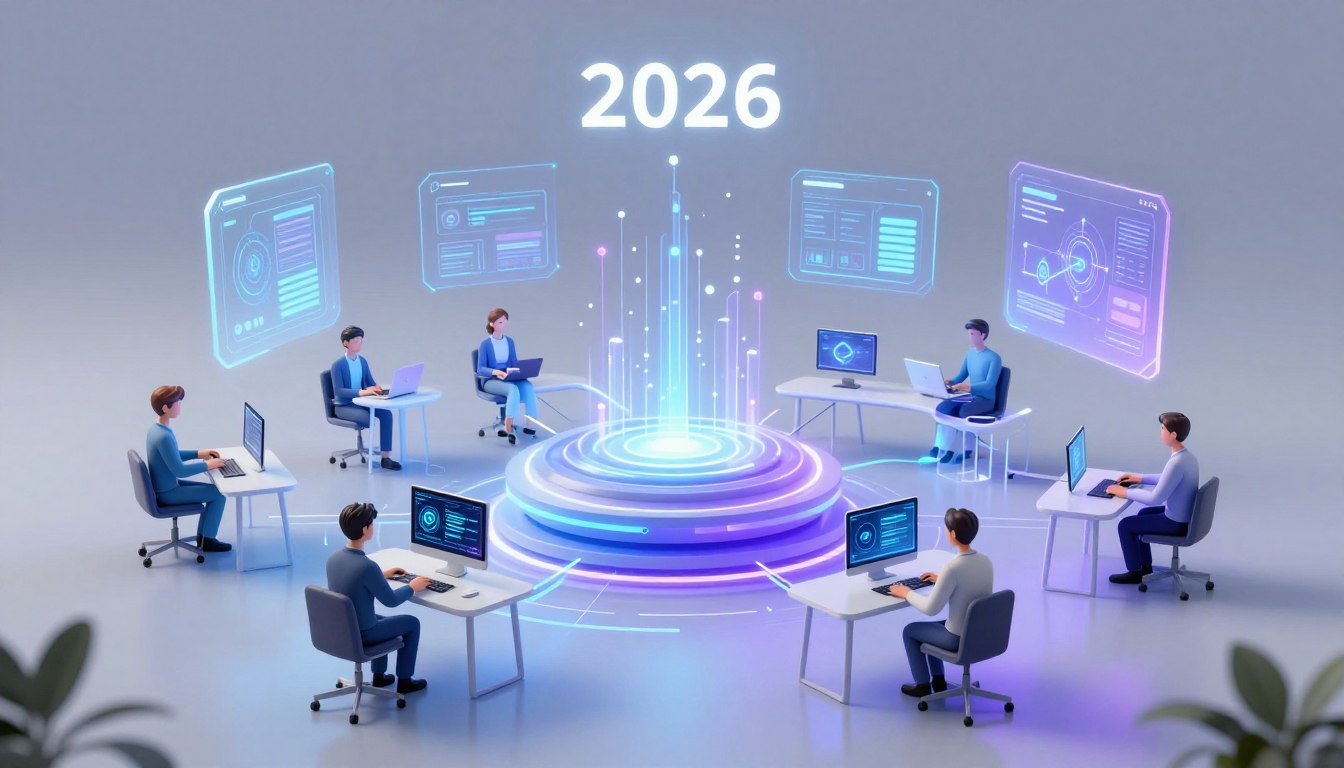
As technology continues to advance at a rapid pace, the year 2026 is expected to be a significant year for artificial intelligence job opportunities. According to Marco Argenti, Goldman Sachs’ chief information officer, “In my 40 years in technology, 2025 saw the biggest changes I have seen in my career,” and he predicts that 2026 will be an even bigger year for change.
The increasing demand for AI professionals is driven by technological advancements and economic factors. As future artificial intelligence careers continue to evolve, it’s crucial to understand the current state and future direction of AI employment.
Key Takeaways
- The year 2026 is expected to be a significant year for AI job opportunities.
- Technological advancements and economic factors will shape the AI industry.
- The demand for AI professionals is increasing rapidly.
- Understanding the current state and future direction of AI employment is crucial.
- Emerging job prospects in the AI sector are expected to grow.
The Current State and Future Direction of AI Employment
The AI job market is on the cusp of a significant transformation, influenced by both technological innovations and economic investments. As we approach 2026, understanding the current state and future direction of AI employment is crucial for professionals and organizations alike.
Today’s AI Job Market vs. Tomorrow’s Possibilities
The current AI job market is characterized by rapid growth, with machine learning positions being in high demand. As AI technology advances, we can expect new job opportunities to emerge, potentially shifting the focus towards AI ethics and governance. Tomorrow’s possibilities may include more sophisticated AI applications across various industries.
Key Technological Advancements Driving Job Creation
Technological advancements, particularly in artificial intelligence and machine learning, are driving job creation in areas such as AI development, deployment, and maintenance. The increasing complexity of AI models is expected to create new job opportunities in fields like AI explainability and transparency.
Economic Factors Shaping AI Career Opportunities
Economic factors, including significant investments in AI infrastructure, are shaping AI career opportunities. For instance, Wall Street analysts expect the largest hyperscale cloud computing companies to invest over half a trillion dollars in capital expenditures in 2026, potentially leading to an increase in artificial intelligence job opportunities across various sectors.
AI Jobs in 2026: Top 10 High-Demand Positions
As AI continues to reshape industries, certain roles are emerging as high-demand positions in 2026. According to recent research, companies are struggling to deliver measurable returns on their AI investments, with Gartner finding that only one in 50 AI investments deliver transformational value. This highlights the need for professionals who can bridge the gap between AI technology and business outcomes.
The top high-demand AI roles can be categorized into several key areas. Let’s explore some of the most critical positions:
AI Ethics and Governance Specialists
As AI becomes more pervasive, companies are recognizing the need for AI ethics and governance specialists who can ensure that AI systems are developed and deployed responsibly. These professionals will play a crucial role in shaping the future of AI.
Advanced Machine Learning Engineers
Advanced machine learning engineers are in high demand, as they can design and implement complex AI models that drive business value. Their expertise is crucial for companies looking to leverage AI for competitive advantage.
Human-AI Interaction Designers
The need for human-AI interaction designers is growing, as companies seek to create AI systems that are intuitive and user-friendly. These designers will be responsible for crafting seamless interactions between humans and AI.
Neural Architecture Engineers
Neural architecture engineers are critical for developing efficient and effective AI models. Their work will be essential for advancing AI capabilities in various industries.
Enterprise AI Implementation Strategists
As AI adoption grows, enterprise AI implementation strategists will be in high demand to help companies integrate AI into their operations. These strategists will develop and execute AI strategies that drive business success.
| Role | Key Responsibilities | Demand Level |
|---|---|---|
| AI Ethics and Governance Specialists | Ensure responsible AI development and deployment | High |
| Advanced Machine Learning Engineers | Design and implement complex AI models | Very High |
| Human-AI Interaction Designers | Craft intuitive human-AI interactions | High |
| Neural Architecture Engineers | Develop efficient AI models | Very High |
| Enterprise AI Implementation Strategists | Develop and execute AI strategies | High |
Essential Skills for Success in Future AI Careers
The rapidly changing AI landscape necessitates a workforce with advanced technical competencies and critical soft skills. As AI continues to integrate into various industries, the demand for professionals who can develop, implement, and manage AI systems effectively is on the rise.
Technical Competencies Beyond Basic Programming
To succeed in future AI careers, professionals need to possess technical competencies that go beyond basic programming. This includes:
Mathematical Foundations and Statistical Analysis
A strong foundation in mathematics and statistical analysis is crucial for understanding AI algorithms and models.
Domain-Specific AI Applications
Knowledge of how AI is applied in specific domains, such as healthcare or finance, is essential for developing targeted solutions.
System Architecture and Integration
Understanding how to integrate AI systems with existing infrastructure is vital for seamless implementation.
Critical Soft Skills for AI Professionals
In addition to technical skills, critical soft skills are necessary for AI professionals to work effectively in teams and communicate with stakeholders. These include:
Ethical Decision-Making
AI professionals must be able to make ethical decisions regarding the development and deployment of AI systems.
Cross-Functional Collaboration
The ability to collaborate across different departments and disciplines is crucial for successful AI project implementation.
Explaining Complex AI Concepts to Non-Specialists
Being able to explain complex AI concepts in simple terms is essential for stakeholder buy-in and effective project management.
Interdisciplinary Knowledge Requirements
The future of AI careers demands interdisciplinary knowledge, combining insights from computer science, domain-specific expertise, and understanding of human factors. Professionals who can bridge these disciplines will be best positioned to succeed in the evolving AI landscape.
Emerging Job Prospects in the AI Sector by Industry
As AI continues to evolve, it’s creating new job opportunities across various industries. The integration of AI is transforming the job market, bringing forth new career paths in diverse sectors.
Healthcare AI Specialists and Medical Algorithm Developers
The healthcare industry is witnessing a significant transformation with the advent of AI. AI jobs in healthcare are on the rise, with specialists developing medical algorithms that improve diagnosis and treatment. These professionals work on creating AI-powered systems that can analyze medical data, predict patient outcomes, and personalize treatment plans.
Financial AI Risk Analysts and Algorithmic Traders
In the financial sector, AI is being used to analyze risk and optimize trading strategies. Financial AI risk analysts and algorithmic traders use AI algorithms to predict market trends, identify potential risks, and make informed investment decisions. Their work involves developing and implementing AI models that can process vast amounts of financial data.
Manufacturing and Supply Chain AI Optimization Experts
AI is also revolutionizing the manufacturing and supply chain industries by improving efficiency and reducing costs. Experts in this field develop and implement AI solutions that optimize production processes, predict maintenance needs, and streamline supply chain operations.
Educational AI Curriculum Designers
The education sector is another area where AI is making a significant impact. Educational AI curriculum designers create personalized learning experiences using AI-powered tools. They develop curricula that incorporate AI, ensuring students are equipped with the skills needed to thrive in an AI-driven world.
Creative Industry AI Collaborators
AI is also being used in the creative industry to generate new forms of art, music, and content. AI collaborators work alongside human creatives to produce innovative works that push the boundaries of artistic expression.
In conclusion, the emerging job prospects in the AI sector are diverse and widespread across various industries. As AI continues to evolve, it’s likely to create even more new career paths and opportunities.
Education and Training Pathways for 2026 AI Positions
The rapidly evolving AI landscape demands innovative education and training strategies to prepare professionals for future challenges. As AI continues to transform industries, the need for specialized knowledge and skills is becoming increasingly important.
Evolution of Academic Programs for AI Specialization
Academic programs are adapting to the changing AI landscape by introducing specialized AI courses and degree programs. These programs focus on providing a deep understanding of AI technologies, including machine learning, natural language processing, and computer vision. Universities are also collaborating with industry partners to ensure that the curriculum remains relevant to current industry needs.
Industry-Recognized Certifications and Micro-Credentials
Industry-recognized certifications are becoming increasingly valuable in the AI job market. These certifications demonstrate expertise in specific AI technologies or methodologies and are often provided by leading technology companies. Micro-credentials offer another pathway, allowing professionals to gain recognition for specific skills without committing to full degree programs.
Self-Directed Learning Resources and Professional Communities
The rise of self-directed learning resources, including online courses and tutorials, has made it easier for individuals to acquire AI skills. Professional communities and forums also play a crucial role, providing a platform for networking, knowledge sharing, and collaboration. These resources are essential for professionals looking to stay up-to-date with the latest AI developments.
Career Growth and Compensation in Artificial Intelligence
As AI continues to reshape industries, professionals in this field can expect significant career growth and competitive compensation packages. The increasing demand for AI expertise is driving up salaries and creating new opportunities for advancement.
Projected Salary Ranges for Senior vs. Entry-Level AI Roles
Salary ranges in AI vary significantly based on experience and role. Entry-level positions start around $80,000-$120,000 annually, while senior roles can command $200,000-$300,000 or more, depending on factors like location and industry.
Career Advancement Trajectories in Corporate vs. Research Settings
Career advancement in AI can follow different paths in corporate versus research settings. Corporate environments often offer structured career progression, while research settings may provide more flexibility and opportunities for innovation.
Geographic Distribution of High-Paying AI Opportunities
The geographic distribution of high-paying AI opportunities is evolving. Traditional tech hubs remain strong, but emerging AI centers and remote work possibilities are becoming increasingly attractive.
Traditional Tech Hubs
- Silicon Valley
- New York City
- Seattle
Emerging AI Centers
- Denver
- Austin
- Boston
Remote Work Possibilities
With the rise of remote work, AI professionals can now access high-paying opportunities from anywhere, expanding their career options beyond traditional tech hubs.

Understanding these trends can help AI professionals navigate their careers effectively and capitalize on the growing demand for their skills.
Navigating Ethical Challenges in Future AI Employment
The future of AI employment is not just about technological advancements, but also about navigating complex ethical challenges. As AI becomes increasingly integrated into various industries, it’s crucial to address the ethical implications of its development and deployment.
Responsible AI Development Practices
Developing AI responsibly involves creating systems that are transparent, explainable, and fair. This includes implementing robust testing protocols to identify and mitigate biases, as well as ensuring that AI systems are designed with privacy and security in mind.
Regulatory Compliance and Privacy Protection
As AI continues to evolve, regulatory frameworks are being developed to ensure that AI systems comply with existing laws and regulations. This includes data protection regulations such as GDPR and CCPA, which mandate how personal data is collected, stored, and used by AI systems.
Balancing Innovation with Societal Impact
One of the key ethical challenges in AI is balancing the need for innovation with the potential societal impact of new technologies. This involves considering the potential consequences of AI on employment, society, and the environment, and developing strategies to mitigate any negative effects.
By adopting responsible AI development practices, ensuring regulatory compliance, and balancing innovation with societal impact, we can navigate the ethical challenges associated with AI employment and create a future where AI benefits society as a whole.
Strategic Preparation for High-Demand AI Roles
To succeed in the evolving AI landscape, individuals must focus on strategic preparation and continuous learning. As AI technology advances, the job market is expected to shift significantly, creating new opportunities and challenges for professionals.
Developing a Specialized AI Portfolio
Creating a specialized AI portfolio is crucial for demonstrating expertise and attracting potential employers. This involves showcasing projects that highlight technical skills and problem-solving abilities.
Project Selection and Documentation
Carefully selecting projects that demonstrate a range of AI skills is essential. Proper documentation of these projects, including the challenges faced and solutions implemented, will make the portfolio more compelling.
Demonstrating Real-World Problem Solving
Employers value professionals who can apply AI to real-world problems. Including projects that address practical issues can significantly enhance a portfolio.

Building Professional Networks in AI Communities
Building a strong network within AI communities can provide access to job opportunities, collaborations, and valuable insights. Engaging in online forums, attending conferences, and participating in hackathons are effective ways to build these connections.
Continuous Learning Strategies for Rapidly Evolving AI Fields
The AI field is characterized by rapid evolution, making continuous learning a necessity. Professionals should stay updated with the latest research, technologies, and methodologies through online courses, webinars, and industry publications.
Transitioning from Traditional Tech Roles to AI Specialization
For those in traditional tech roles, transitioning to AI specialization requires a strategic approach. This involves acquiring relevant AI skills, gaining practical experience, and potentially pursuing additional education or certifications in AI.
Conclusion: Embracing the Future of AI Career Opportunities
As AI continues to evolve, it’s clear that the future of AI career opportunities will be shaped by technological advancements, economic factors, and the need for continuous learning and adaptation. Professionals who embrace AI and develop the necessary skills will be well-positioned to capitalize on emerging opportunities.
The job market is expected to shift towards high-demand positions such as AI ethics and governance specialists, advanced machine learning engineers, and human-AI interaction designers. To succeed in these roles, individuals will need to possess technical competencies, critical soft skills, and interdisciplinary knowledge.
By understanding the current state and future direction of AI employment, professionals can prepare themselves for the changing job market and drive ai career growth. Embracing AI requires a commitment to lifelong learning, strategic preparation, and a willingness to adapt to new technologies and innovations.
As the AI landscape continues to evolve, it’s essential to stay informed about the latest developments and trends. By doing so, professionals can unlock the full potential of the future of ai career opportunities and thrive in a rapidly changing job market.





Comments are closed