

We are at a pivotal moment in digital intelligence’s evolution. The industry is moving from generic language models to specialized, reliable systems. These systems are designed for complex enterprise needs.
Recent research from leaders like Salesforce shows a big change. Businesses now focus on precision and safety over broad solutions. This change marks a new era where technology fits smoothly into our daily lives. It solves specific, high-stakes problems.
It’s key for any organization to understand these changes to stay ahead. By focusing on data integrity and domain-specific accuracy, we can navigate the next decade’s innovations. Let’s explore this path together.
Key Takeaways
- Shift from generic models to specialized enterprise solutions.
- Increased focus on reliability and safety in complex environments.
- Salesforce research indicates a move toward domain-specific accuracy.
- Integration of technology into core business operations is accelerating.
- Strategic planning is vital for long-term success in this evolving landscape.
The State of Artificial Intelligence Advancements in 2026
In 2026, artificial intelligence is evolving from simple tools to smart problem solvers. We’re seeing a big technology evolution. Machines are now learning to do more on their own, changing how we live and work.
Current Milestones in Generative AI
Generative AI has grown a lot, moving from testing to being essential in business. Now, companies focus on making AI reliable and accurate. It’s becoming a key part of our daily work, giving us insights before we even ask.
Developers are now focusing on the whole system, not just the AI model. This makes AI more stable and trustworthy. It’s becoming a seamless part of our work lives.
The Shift from Large Language Models to Agentic Systems
The industry is moving towards more dynamic AI systems. Salesforce AI Research labs are testing these systems in real-world settings. These AI agents can do more than just answer questions; they can complete tasks on their own.
This change is a big step in software development. These systems work on their own, without needing a prompt. The table below shows how these two types of AI differ.
| Feature | Traditional LLMs | Agentic Systems |
|---|---|---|
| Primary Function | Content Generation | Task Execution |
| User Interaction | Reactive | Proactive |
| Autonomy Level | Low | High |
| Workflow Role | Support Tool | Process Manager |
Predicting Future AI Trends After 2026
Looking ahead, future AI trends after 2026 will change how we interact with machines. We’re moving from fixed systems to a more flexible digital world. This change is a big step forward in how software understands us.
The shift is not just about being faster; it’s about contextual awareness. Soon, systems will guess what we need before we ask. This makes technology a reliable, always-available partner.
The Move Toward Multimodal Integration
Future AI trends will blend different data types smoothly. Modern systems can handle text, images, and audio at the same time. This multimodal integration leads to a deeper understanding of the world.
Users will talk to AI, use visual cues, and interact with their environment. This approach lets machines see the whole picture of a task. It makes the user experience more natural and intuitive, like working together.
Advancements in Real-Time Reasoning Capabilities
The move to real-time reasoning is exciting for knowledge workers. Systems are getting better at handling fast-changing environments. This lets AI give instant, actionable insights when needed.
Ambient intelligence is key to this change. AI can watch how professionals work and suggest improvements or automate tasks. This frees people to focus on big-picture strategy, not just data.
Breakthroughs in Deep Learning Architectures
New innovations in deep learning are changing how machines learn and reason. Researchers are pushing the limits, leading to deep learning breakthroughs that focus on speed and accuracy. These changes are moving us toward more flexible, intelligent systems.
Beyond Transformers: Exploring State Space Models
For years, transformers have led in artificial intelligence. But they face challenges with memory when dealing with long data sequences. State Space Models (SSMs) are now seen as a strong alternative.
SSMs are more efficient for handling sequential data. They keep a compact internal state. This means they can process data with linear complexity, unlike traditional attention mechanisms. This makes systems better at keeping context over long periods without losing performance.
Efficiency Gains in Neural Network Training
Training AI models today needs a lot of data, but real-world data is hard to get. To solve this, engineers use advanced simulation environments like eVerse. These platforms let agents train on thousands of synthetic scenarios in a virtual space.
Using these environments leads to big deep learning breakthroughs without needing expensive real-world data. This makes models strong against the noise and unpredictability of daily business.
Switching to these optimized training methods brings many benefits for businesses:
- Reduced Training Time: Synthetic scenarios speed up learning for complex tasks.
- Enhanced Reliability: Models tested in various virtual environments work better in real life.
- Lower Operational Costs: Automated simulation cuts down on manual data labeling and physical testing.
The Evolution of Autonomous Machine Learning Systems
Recent advancements in machine learning are leading to a new era of autonomous digital systems. Companies are moving from simple automation to systems that can handle complex tasks on their own. These systems need little to no human guidance.
Self-Correcting Algorithms in Production
Modern production needs reliable systems that traditional software often can’t provide. Self-correcting algorithms help companies keep their models up to date with changing data. This proactive approach keeps systems running smoothly and prevents downtime.
“The future of enterprise software lies in systems that do not just execute commands, but actively monitor their own health and accuracy to ensure continuous improvement.”
These systems use advanced feedback loops to spot problems before they become major issues. If a discrepancy is found, the algorithm adjusts itself to meet current goals. This level of self-management is key in recent machine learning advancements.
Reducing Human Oversight in Data Labeling
Preparing AI datasets is a big challenge. Luckily, new autonomous agents are taking over routine tasks like inventory management and logistics. This cuts down on the need for human help.
By automating these tasks, businesses gain several benefits:
- Increased operational speed by removing manual bottlenecks.
- Higher data accuracy through consistent, machine-led labeling.
- Strategic focus, allowing human teams to focus on creative problem-solving.
As these systems improve, the role of humans is changing. They’re moving from manual tasks to high-level oversight and strategy. This shift is vital for companies aiming to grow in a competitive global market.
Expanding the AI Ecosystem Through Global Collaboration
Creating a strong AI ecosystem is more than just coding. It needs shared standards. As tech gets more complex, working together across borders becomes key. This AI ecosystem expansion is about making sure different systems can talk to each other well.
Open Source Contributions and Industry Standards
Open source projects are the heart of today’s innovation. By sharing code and research, developers worldwide can solve problems quicker than any single company. This teamwork ensures best practices are followed, keeping tools from getting too scattered.
Adopting standardized metadata is a big step. For example, Google has added Agent Cards to their A2A spec. This makes it easy for systems to find out what each can do and if they can trust each other. With these standardized frameworks, developers can make sure their agents work well together, no matter where they are.
Cross-Border Data Sharing Initiatives
For true interoperability, we need safe ways to share data across borders. New projects aim to create spaces where data can be used without risking privacy or security. These efforts are essential for the AI ecosystem expansion, as they help make training data more diverse.
When agents can handle complex negotiations, they bring new efficiency. Trust is the currency of our digital world. By setting up clear, global rules, we can build a future where smart systems work together to tackle global problems in a clear and reliable way.
Emerging AI Applications in Healthcare and Biotechnology
The world of medicine is changing fast thanks to smart technology. These emerging AI applications help turn raw biological data into useful insights for doctors. They can process huge amounts of information, improving patient care.

Precision Medicine and Genomic Sequencing
Precision medicine means treatments fit each person’s unique genetic makeup. Advanced algorithms look through huge genomic datasets to find disease-causing mutations. This personalized approach makes treatments more effective and reduces side effects.
High standards in healthcare require new training methods. For example, a UCSF Health pilot used simulation training for AI agents. It achieved 88% task coverage, making sure the tech is reliable and accurate with patient data.
“The future of medicine lies in our ability to decode the human genome and translate that knowledge into precise, life-saving interventions.”
AI-Driven Drug Discovery Pipelines
Bringing a new drug to market used to take a long time and cost a lot. Now, emerging AI applications are changing this by predicting how chemicals interact with biological targets. They can test millions of molecules much faster than old lab methods.
This speed-up helps researchers tackle rare diseases that were hard to study before. The computational efficiency is a big win for the pharmaceutical world. As these tools get better, we’ll see new medicines reach patients faster.
The Rise of Predictive Analytics in Financial Markets
Predictive analytics is changing how global markets work and handle risk. Financial institutions are now using proactive, data-driven strategies to predict market changes before they happen. This shift is key to staying ahead in a complex economic world.
High-Frequency Trading and Risk Assessment
Today’s trading floors use advanced algorithms for fast order execution. These algorithms help firms analyze huge datasets to improve their trading strategies. This precision lets them assess risks in real-time, keeping portfolios stable even when markets are volatile.
Many institutions aim for 99% accuracy in their predictions. Achieving this level of reliability is vital for tasks like automated inventory management and complex financial reconciliations. As predictive analytics grows, the room for mistakes in these critical areas gets smaller.
“The future of finance lies in the ability to turn massive amounts of raw data into actionable intelligence in milliseconds.”
Detecting Fraud with Behavioral Biometrics
Security is a major focus for digital banking. Behavioral biometrics offer a robust layer of protection by studying user patterns. If an unusual pattern is found, the system can quickly identify it as a possible security risk.
This technology is a big step up in fighting financial fraud. It looks at how users interact with platforms, not just their login details. As predictive analytics grows, these security systems get smarter and more flexible with each use.
Ethical Governance and Regulatory Shifts in Technology
Artificial intelligence is now a big part of our lives. We need robust ethical governance more than ever. People want these systems to be efficient, fair, trustworthy, and accountable to human values.
This change is ushering in a new era. Innovation must now balance progress with safety.
The Impact of the AI Act and Global Compliance
Stricter standards are being set to manage AI risks. The AI Act is a key piece of legislation. It sets high standards for AI development and deployment.
It encourages developers to focus on safety from the start. This helps ensure AI systems are safe and reliable.
Global regulatory compliance is now a must for tech firms. Companies that follow these standards are better ready for audits and public scrutiny. This builds trust with users who care about their data.
Transparency Requirements for Algorithmic Decision Making
There’s a growing need for algorithmic transparency. Users want to know why certain decisions are made, in areas like finance or healthcare. When systems are not transparent, it’s hard to spot bias or errors.
Companies are investing in explainable AI to meet these needs. By showing how their algorithms work, businesses can prove they’re fair. This openness is key to keeping public trust in the digital world.
| Region | Primary Regulatory Focus | Compliance Level |
|---|---|---|
| European Union | Risk-based AI Act | High |
| United States | Sector-specific guidelines | Moderate |
| Asia-Pacific | Innovation-led frameworks | Developing |
Hardware Innovations Powering Next-Generation Models
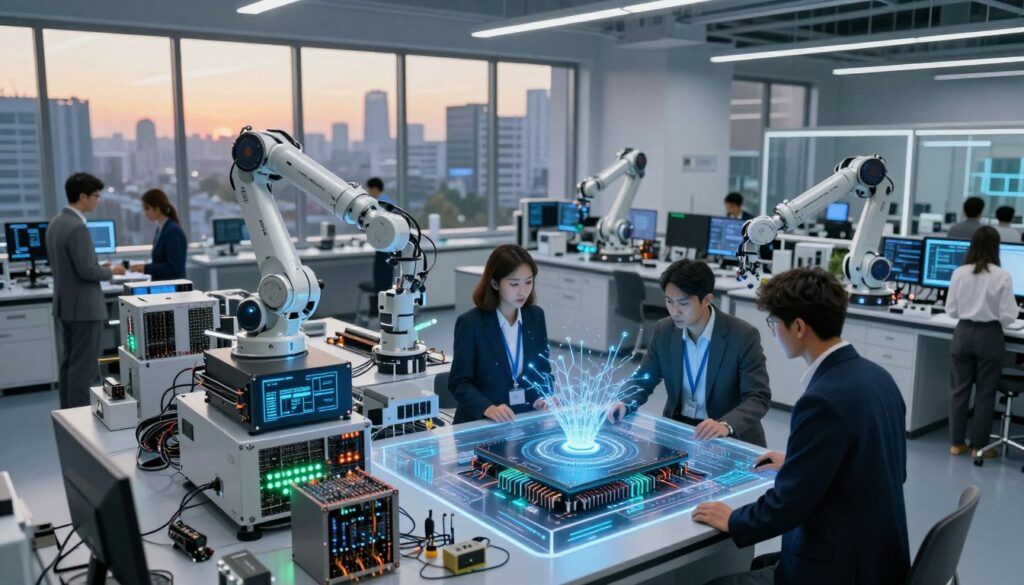
Every advanced AI model relies on cutting-edge hardware. As software needs grow, so does the need for better hardware. This ensures AI stays fast, reliable, and easy to use on many devices.
Specialized Silicon for Edge Computing
Edge computing is changing the game for real-time apps. It lets devices process data locally, cutting down on delays. This is key for things like self-driving cars or smart home tech.
Now, engineers are making specialized silicon for these tasks. These chips are efficient and powerful for local tasks. The benefits include:
- Lower Latency: Data is processed closer to where it’s needed.
- Enhanced Privacy: Data stays on the device, keeping it safe.
- Offline Reliability: AI works even without the internet.
Advancements in Neuromorphic Computing Chips
Researchers are also working on neuromorphic computing. These chips are designed to work like the brain, using spikes to process info. This uses less energy, making devices that last longer without needing to recharge.
The table below shows how new chips differ from old ones:
| Feature | Traditional GPU | Neuromorphic Chip |
|---|---|---|
| Energy Usage | High | Very Low |
| Processing Style | Batch/Parallel | Event-Driven |
| Primary Use | Model Training | Real-time Inference |
These advancements are key to the future of tech. By combining specialized silicon with brain-like designs, we’re making AI a part of our everyday lives. This means our devices will get smarter, faster, and more efficient every day.
Human-AI Collaboration in the Modern Workforce
The technology evolution is changing how we work with artificial intelligence. Instead of seeing machines as rivals, companies now see them as valuable team members. This change lets workers focus on solving big problems, not just doing routine tasks.
Augmenting Creative Processes with AI Tools
AI is transforming creative work. Designers, writers, and engineers use AI tools to break through creative barriers. These tools help them work faster and come up with new ideas.
Using these tools brings many benefits to creative work:
- Rapid Prototyping: Quickly see ideas before they’re finalized.
- Enhanced Personalization: Make content fit specific groups with data insights.
- Workflow Automation: Get rid of tasks that take away from creativity.
Reskilling Initiatives for the AI-Driven Economy
The fast pace of technology evolution means we need to keep learning. As AI handles simple tasks, we must focus on strategy and emotional skills. Companies are investing in training to help workers adapt.
The table below shows how work skills are changing:
| Skill Category | Traditional Focus | AI-Driven Focus |
|---|---|---|
| Data Management | Manual Entry | Strategic Interpretation |
| Problem Solving | Rule-Based Logic | Complex Decision Making |
| Communication | Standard Reporting | Contextual Storytelling |
Continuous learning is key in this new world. By keeping up with training, workers stay relevant and use new tools to improve. The goal is to work together, with humans guiding AI’s precision.
Environmental Impact and Sustainable AI Development
We need to think differently about powering our tech to make it greener. As we ask for more computing power, we’re focusing on sustainable innovation. This is key to growing our digital world without harming the planet.
Green Data Centers and Energy-Efficient Training
Our tech’s energy needs are changing fast. Companies are using green technology to cut down energy use in data centers. They’re using better cooling and renewable energy to save a lot of power.
Developers are also working on energy-efficient training methods. These methods let models learn from data using less electricity. This cuts costs and reduces the load on power grids.
Carbon Footprint Tracking for Large Models
Being open about our environmental impact is important. Companies are tracking their carbon footprint to see how much they emit. This helps us understand the environmental cost of big tech systems.
Tracking this way helps us set goals to reduce our ecological footprint. It keeps developers working on efficient, powerful models that care for the planet. Our aim is to grow tech while keeping our planet safe.
Conclusion
The future beyond 2026 is exciting. Technology will go from being a simple tool to a constant partner. This change will affect how businesses work and how we use digital systems every day.
Success in this new world depends on being ethical and focusing on people. Companies that care about these values will grow and earn trust. Leaders at Microsoft and Google are setting the standards for safety.
To get ready for this future, keep learning and build strong systems. Stay curious about new discoveries to stay ahead. Make sure your team has the skills to work with advanced technology.
Now is the time to check your digital strategy. Share your thoughts on how these changes will affect your industry. Your ideas help make the future of technology better for everyone.