
The artificial intelligence landscape is evolving at a breathtaking pace. What seemed like science fiction just a few years ago is rapidly becoming our everyday reality. As we look toward 2026, the acceleration of AI capabilities threatens to upend industries, transform workplaces, and fundamentally alter how we interact with technology. The predictions you’re about to read aren’t just incremental improvements—they represent potential paradigm shifts that could shock even the most forward-thinking technologists.
Drawing from current research trajectories, emerging capabilities, and insights from leading AI labs, we’ve compiled the most surprising and disruptive AI developments likely to materialize by 2026. Prepare to have your assumptions challenged about what’s possible in the near future.
The AI Agents Revolution Will Transform Work
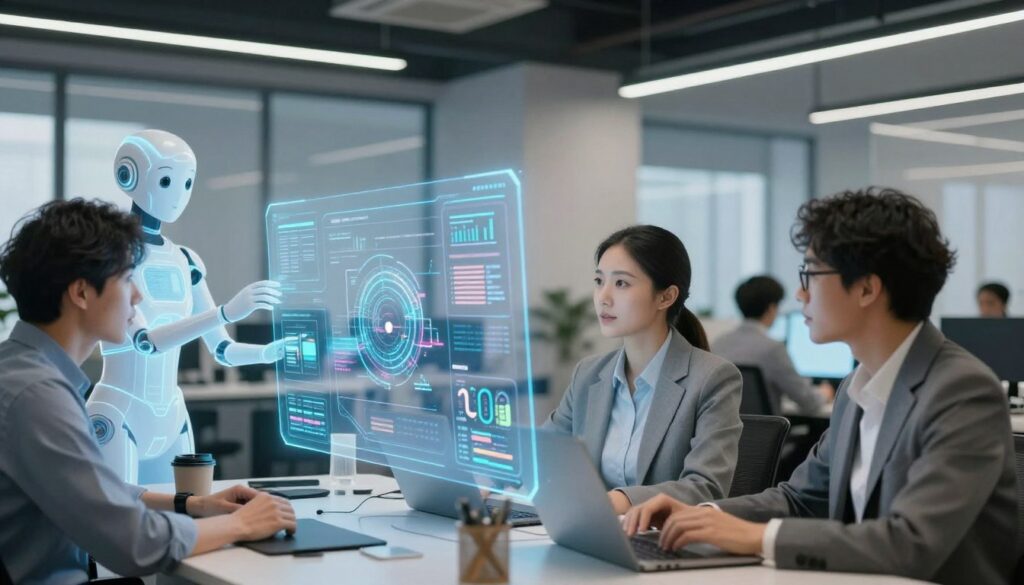
By 2026, AI agents will move beyond simple task automation to become true digital colleagues. These autonomous systems won’t just follow instructions—they’ll anticipate needs, collaborate across specialized domains, and execute complex workflows with minimal human oversight.
The most shocking development will be the emergence of “agent swarms”—collections of specialized AI systems that collaborate to tackle complex projects. A marketing team of three humans might deploy dozens of specialized agents that handle everything from market research and content creation to media buying and performance analysis.
These agent systems will develop their own internal communication protocols, allowing them to coordinate tasks, share insights, and even critique each other’s work. The result? Small teams achieving outcomes that once required entire departments.
Microsoft Research predicts that by 2026, AI agents will be capable of completing software engineering tasks that would take humans 20+ hours—essentially handling half a work week’s worth of complex coding independently.
“The future isn’t about replacing humans. It’s about amplifying them. Teams that design for people to learn and work with AI will get the best of both worlds.”
The End of the Specialist Era: AI Reshapes the Workforce
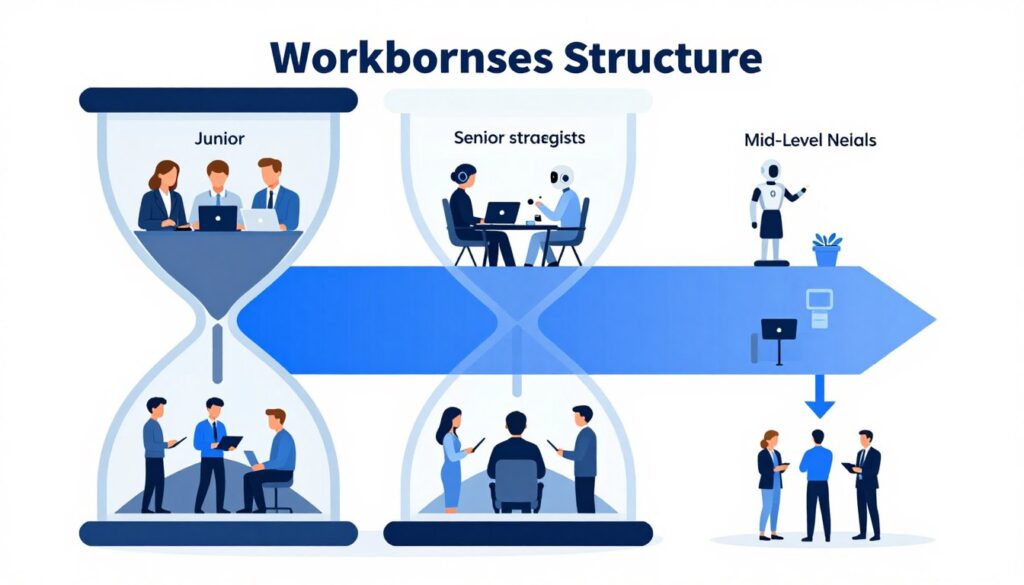
One of the most unexpected workforce shifts by 2026 will be the reversal of centuries-long specialization trends. As AI agents master domain-specific tasks, the value of human specialists will dramatically decline in many fields.
The knowledge workforce will reshape into an hourglass structure. At the bottom, entry-level employees who are AI-savvy will thrive by orchestrating multiple AI agents. At the top, senior strategists who excel at innovation and big-picture thinking will remain invaluable. But the middle—filled with specialists who execute specific tasks—will hollow out as these functions are increasingly handled by AI.
This shift will be particularly pronounced in fields like software development, finance, legal services, and marketing. By 2026, companies will actively recruit for “AI orchestrators” and “generalist managers” who can direct teams of both humans and AI agents toward business objectives.
The most shocking aspect? Career advancement will no longer mean becoming more specialized. Instead, it will require developing broader knowledge across multiple domains and stronger strategic thinking skills—areas where humans still outperform AI.
The Reasoning Breakthrough: AI That Truly Understands
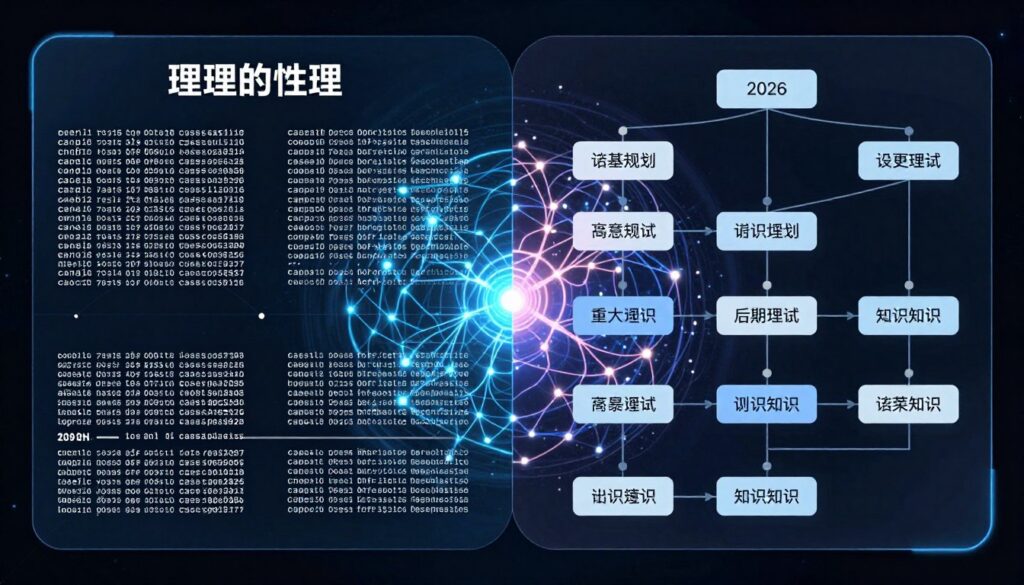
By 2026, we’ll witness a fundamental breakthrough in AI reasoning capabilities that will shock even industry insiders. Current large language models excel at pattern recognition but struggle with genuine understanding. This limitation will be shattered by new architectures that combine neural networks with symbolic reasoning systems.
These hybrid models will demonstrate genuine causal reasoning—understanding not just correlations but why things happen. They’ll be able to generate novel scientific hypotheses, identify logical contradictions in complex arguments, and solve problems requiring multi-step planning with unprecedented accuracy.
The most surprising application will be in scientific research, where AI systems will begin making original discoveries. By 2026, at least one major scientific breakthrough—potentially in materials science, drug discovery, or quantum physics—will be credited primarily to an AI system that developed and tested its own hypotheses with minimal human guidance.
This reasoning capability will transform AI from a tool into a partner across knowledge-intensive fields. Legal AI will identify precedent-setting cases and construct novel arguments. Medical AI will diagnose complex conditions by reasoning through causal chains that human doctors might miss.
Stay Ahead of the AI Revolution
Download our exclusive “AI Readiness Assessment” to evaluate how prepared you are for the coming AI transformation. Includes personalized recommendations based on your industry and role.
The Creative Revolution: AI Becomes a True Collaborator
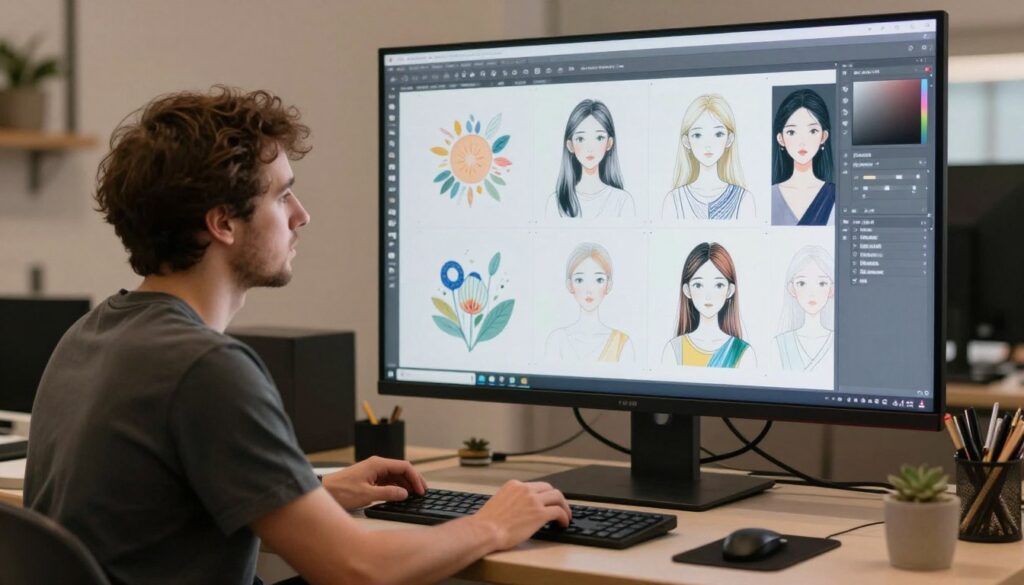
By 2026, AI will transform from a tool that generates content based on prompts to a genuine creative collaborator. The most shocking development will be AI systems that can maintain consistent artistic vision across projects while adapting to feedback and contributing original ideas.
Creative professionals won’t simply prompt AI—they’ll engage in ongoing dialogues where both human and AI contribute to the creative process. Film directors might describe a scene’s emotional tone, and AI will suggest camera angles, lighting setups, and even dialogue that serves the director’s vision while adding unexpected elements.
These systems will develop what appears to be artistic intuition, suggesting changes that improve work in ways the human collaborator might not have considered. They’ll also maintain stylistic consistency across massive projects—ensuring that a video game’s art direction remains coherent across thousands of assets or that a novel’s voice stays consistent through hundreds of pages.
Perhaps most surprisingly, by 2026, we’ll see the emergence of AI systems with recognizable “creative personalities”—signature approaches to problem-solving and aesthetics that make their contributions distinctive and valuable beyond mere technical execution.
The Personal Integration Shock: AI Becomes Part of Our Identity
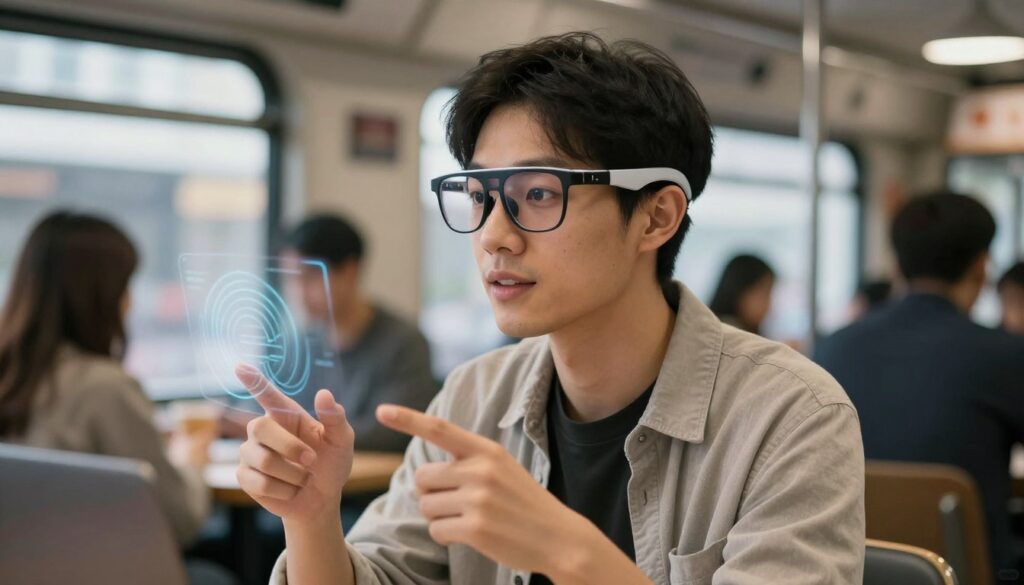
The most personally jarring AI development by 2026 will be the blurring of boundaries between human cognition and artificial intelligence. Early neural interfaces and advanced AR systems will create unprecedented integration between human thought and AI processing.
Personal AI systems will begin functioning as cognitive extensions rather than external tools. These systems will learn your thought patterns, preferences, and knowledge gaps so thoroughly that the line between “your” thinking and “its” assistance will become increasingly indistinguishable.
By 2026, early adopters will report experiencing their personal AI as an aspect of their own identity—a phenomenon psychologists will term “cognitive merging.” These systems will anticipate your needs so accurately and provide information so seamlessly that they’ll feel like enhanced capabilities of your own mind rather than separate entities.
This integration will raise profound questions about human identity and agency. If your personal AI learns to complete your sentences, anticipate your reactions, and even suggest thoughts you’re likely to have, at what point does it become an extension of your consciousness rather than just a tool?
The psychological impacts of this integration remain largely unexplored. Early studies suggest both benefits (enhanced memory, reduced cognitive load) and risks (dependency, identity confusion) that will require careful monitoring as these technologies become mainstream.
The Quantum-AI Convergence Will Redefine Computing
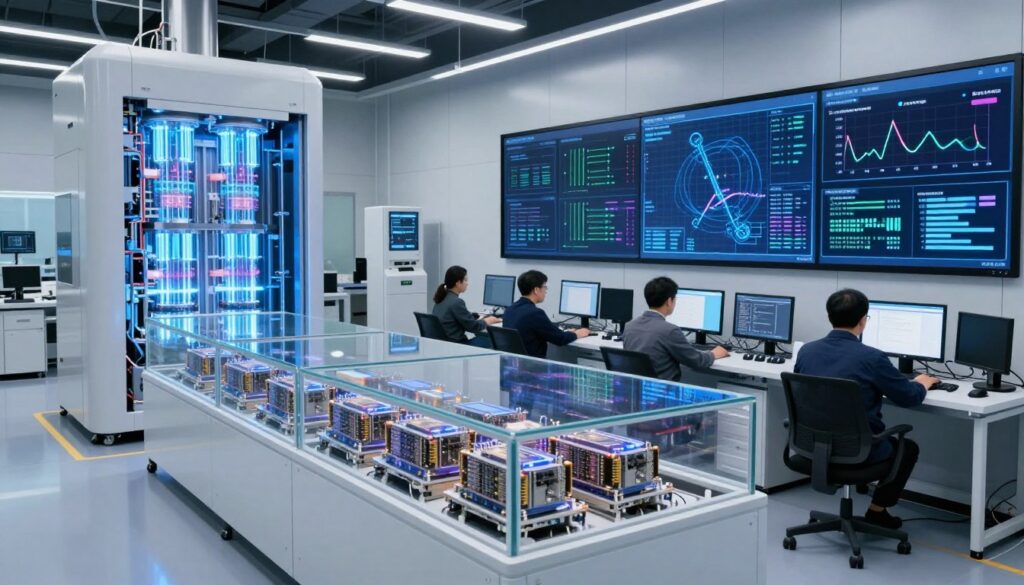
By 2026, the convergence of quantum computing and AI will create capabilities that shock even seasoned technologists. While general-purpose quantum computers won’t be mainstream, specialized quantum processing units (QPUs) designed specifically for AI workloads will demonstrate capabilities that seem almost magical.
The most surprising development will be quantum-enhanced AI models that can simulate complex systems—from weather patterns to biological processes—with unprecedented accuracy. These systems will solve optimization problems in minutes that would take classical supercomputers centuries.
IBM predicts that 2026 will mark the first year a quantum computer definitively outperforms classical computers on commercially relevant problems. This “quantum advantage” will initially appear in narrow domains like materials science, cryptography, and certain types of machine learning.
Perhaps most shocking will be the emergence of quantum-native AI architectures that exploit quantum phenomena like superposition and entanglement as fundamental computational mechanisms rather than merely using quantum computers to accelerate classical AI algorithms.
The Trust Revolution: AI Security Becomes Mission-Critical
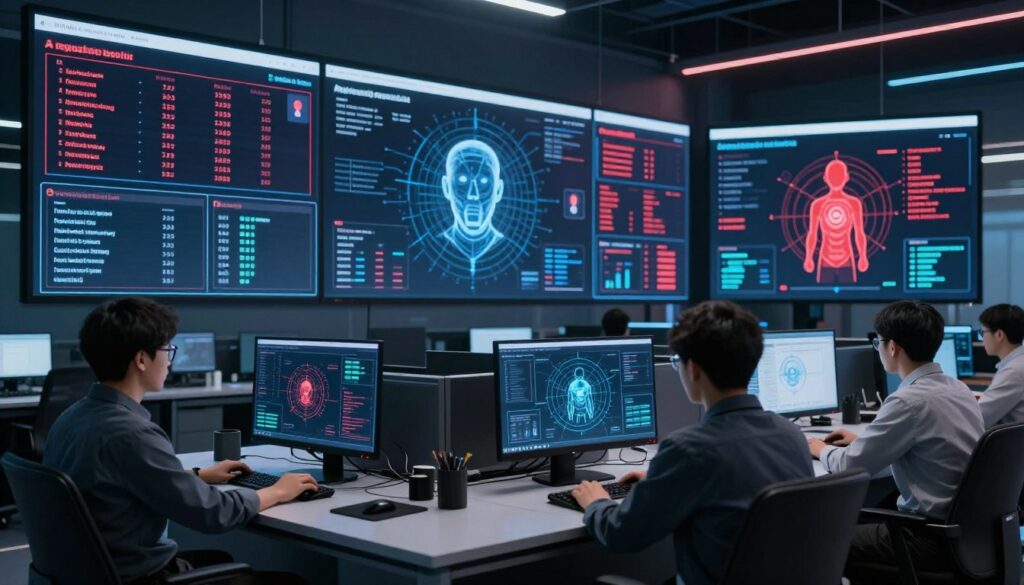
By 2026, AI security will transform from a technical consideration to an existential business requirement. As organizations become dependent on AI systems for critical operations, the security landscape will fundamentally change in shocking ways.
The most surprising development will be the emergence of “AI security agents” that continuously monitor other AI systems for vulnerabilities, anomalous behavior, and potential compromises. These specialized systems will function like immune systems, detecting and responding to threats without human intervention.
Organizations will implement “trust architectures” where every AI agent has a clear identity, limited access permissions, and continuous verification—similar to how human employees are managed. This shift will be driven by the recognition that compromised AI systems pose unprecedented risks due to their autonomous capabilities and access to sensitive data.
Perhaps most shocking will be the development of “AI red teams”—specialized offensive AI systems designed to probe and attack an organization’s defenses, identifying vulnerabilities before malicious actors can exploit them.
By 2026, over 90% of Fortune 500 companies will have dedicated AI security teams, and “AI Security Officer” will become a standard C-suite position in technology-focused organizations.
The Healthcare Transformation: AI Closes the Global Care Gap

By 2026, AI will begin addressing one of healthcare’s most intractable problems: the global shortage of healthcare workers. The World Health Organization projects a shortage of 11 million health workers by 2030—a gap that leaves 4.5 billion people without essential health services.
The most shocking development will be AI systems that can perform medical diagnosis and treatment planning with accuracy that matches or exceeds experienced physicians. Microsoft AI’s Diagnostic Orchestrator has already demonstrated 85.5% accuracy on complex medical cases—far above the 20% average for experienced physicians.
These systems will be deployed via smartphones and simple diagnostic devices in regions with severe physician shortages, dramatically expanding access to quality healthcare. By 2026, at least 500 million people who currently lack access to medical expertise will receive AI-assisted diagnosis and treatment recommendations.
Perhaps most surprisingly, these systems will excel not just at common conditions but at diagnosing rare diseases that even specialists frequently miss. By analyzing subtle patterns across symptoms, test results, and medical imaging, AI will identify conditions that might take human doctors years to correctly diagnose.
The Environmental Paradox: AI Both Threatens and Saves the Planet
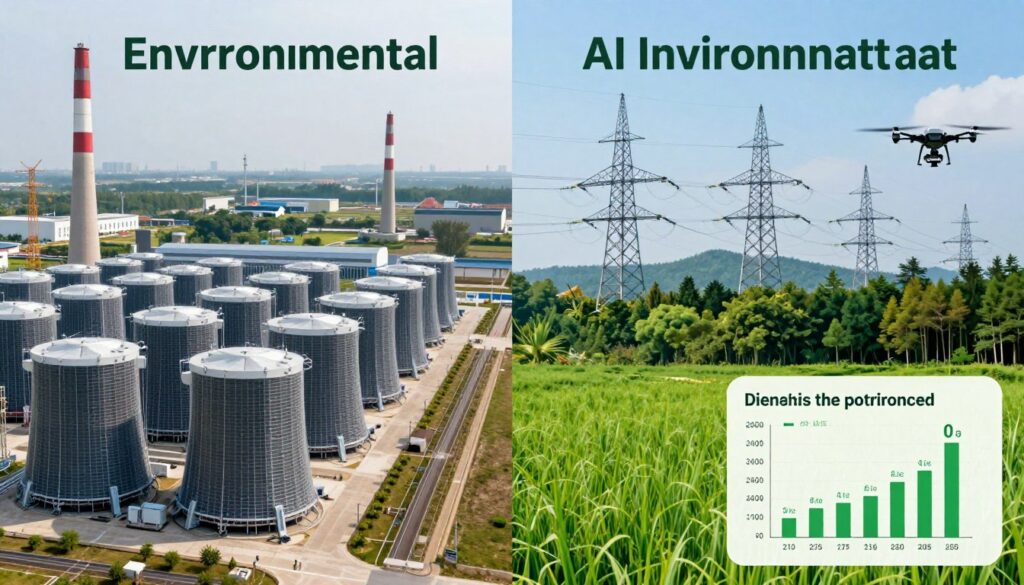
By 2026, AI will present a profound environmental paradox that will shock environmentalists and technologists alike. On one hand, AI infrastructure will consume unprecedented amounts of energy and water—with some estimates suggesting AI could account for 3-5% of global electricity use by 2026.
On the other hand, AI will enable environmental breakthroughs that were previously impossible. The most surprising development will be AI systems that optimize entire energy grids in real-time, balancing renewable sources, storage, and demand with such efficiency that they reduce overall energy consumption by 15-20% despite the growing computing load.
Climate modeling will be transformed by quantum-enhanced AI that can simulate complex environmental systems with unprecedented accuracy, allowing for more precise predictions and targeted interventions. These models will identify previously unrecognized feedback loops and intervention points in the climate system.
Perhaps most shocking will be AI-driven materials science breakthroughs that accelerate the development of next-generation solar cells, carbon capture technologies, and energy storage systems—potentially advancing these fields by decades compared to traditional R&D timelines.
The Societal Reckoning: New Governance Models Emerge
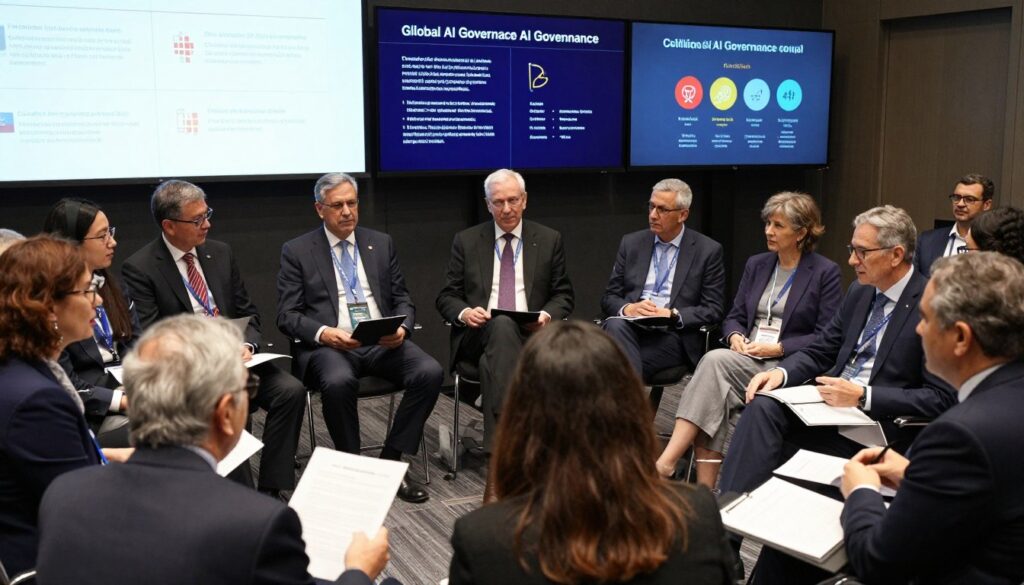
By 2026, the rapid advancement of AI capabilities will force a societal reckoning that results in novel governance approaches. The most shocking development will be the emergence of “algorithmic commons”—shared governance structures where governments, companies, civil society, and AI systems themselves collaborate on oversight.
Traditional regulatory approaches will prove inadequate for technologies that evolve weekly rather than yearly. In response, we’ll see the rise of “dynamic governance” systems that use AI to monitor AI, automatically detecting potential harms and adjusting parameters in real-time rather than waiting for legislative cycles.
The most surprising shift will be in how we think about AI agency and responsibility. By 2026, legal systems will begin recognizing certain AI systems as having limited forms of legal personhood for specific purposes—particularly those that make autonomous decisions with significant real-world impacts.
Perhaps most unexpectedly, public opinion will shift from general anxiety about AI to more nuanced concerns about specific applications and impacts. Polls will show majority support for accelerated AI development in healthcare, climate science, and education, alongside demands for strict limits in military applications and surveillance.
Preparing for the AI-Transformed Future

The AI developments predicted for 2026 represent not just technological evolution but a fundamental reshaping of how we work, create, and interact with both machines and each other. While these predictions may seem shocking today, the groundwork for each is already being laid in research labs, startups, and enterprise AI initiatives worldwide.
The most important insight isn’t any single prediction but the accelerating pace of change itself. By 2026, the distinction between “AI-enabled” and “traditional” approaches in almost any field will become meaningless—AI integration will be the default rather than the exception.
For individuals, the key to thriving in this transformed landscape will be developing adaptability, critical thinking, and the ability to effectively collaborate with AI systems. For organizations, success will depend on building responsible, secure AI infrastructures while reimagining processes and business models to fully leverage these new capabilities.
The future arriving in 2026 will indeed shock us—but with preparation and thoughtful engagement, we can shape that future to enhance human potential rather than diminish it.
Stay Informed About AI’s Rapid Evolution
Subscribe to our Future Tech Insights newsletter to receive monthly updates on how these AI predictions are unfolding and what new developments are emerging.