
The web development landscape is undergoing a profound transformation, driven by artificial intelligence that’s reshaping how websites and applications are built. AI-driven web development tools are no longer just futuristic concepts—they’re practical solutions already changing how developers work and businesses operate online. From automating repetitive coding tasks to generating entire websites from simple text prompts, these tools are democratizing web creation while simultaneously pushing the boundaries of what’s possible.
As we approach 2025, the integration of AI in web development is accelerating at an unprecedented pace. Developers who embrace these technologies gain significant advantages in efficiency, creativity, and problem-solving capabilities. Meanwhile, businesses benefit from faster development cycles, reduced costs, and more innovative digital experiences. This article explores how AI is revolutionizing web development and what you can expect as these technologies continue to evolve.
Key Trends in AI-Driven Web Development
The rapid evolution of AI technologies is introducing revolutionary capabilities to web development workflows. These innovations are not just incremental improvements—they represent fundamental shifts in how websites and applications are conceived, built, and maintained.
AI tools are transforming how developers approach web projects in 2025
Automated Code Generation
One of the most significant advancements in AI-driven web development is the ability to generate code automatically. These tools can now produce complex HTML, CSS, and JavaScript from simple natural language descriptions or visual references.
Machine Learning for Personalized UX Design
AI is revolutionizing user experience design by enabling unprecedented levels of personalization and optimization based on user behavior patterns.

Machine learning enables highly personalized user experiences based on behavioral data
AI-Powered Debugging and Testing
The testing and debugging phase of web development has traditionally been time-consuming and prone to human error. AI tools are transforming this process with automated, intelligent solutions.
Ready to streamline your development workflow?
Discover how AI tools can cut your development time in half while improving code quality.
Real-World Applications: Case Studies
To understand the practical impact of AI-driven web development tools, let’s examine how leading companies are implementing these technologies to transform their development processes and outcomes.
GitHub Copilot: Revolutionizing Code Creation
GitHub Copilot has emerged as one of the most influential AI coding assistants, fundamentally changing how developers write code across organizations of all sizes.
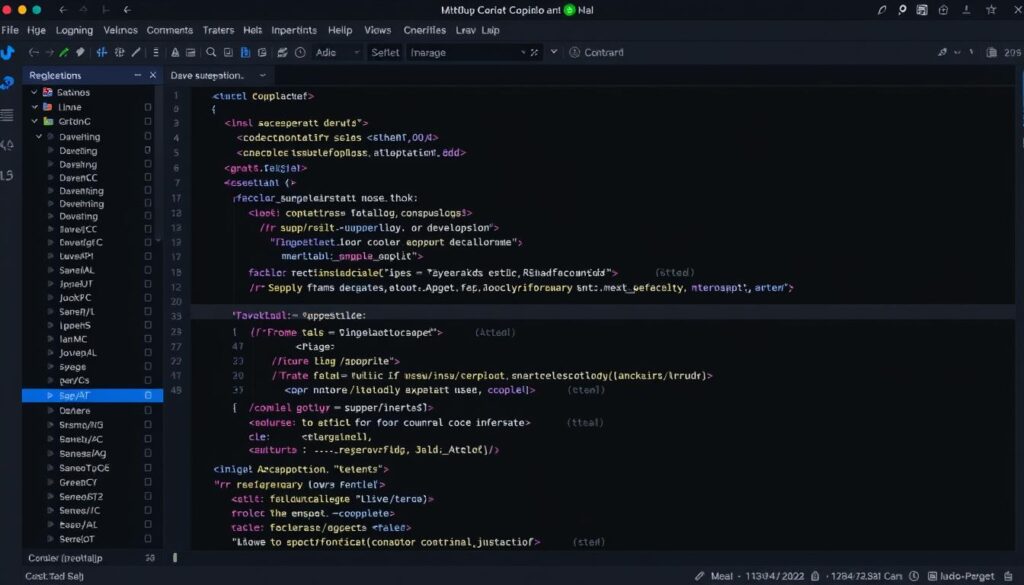
GitHub Copilot providing intelligent code suggestions in real-time
How Airbnb Accelerated Development with GitHub Copilot
Airbnb’s engineering team implemented GitHub Copilot across their development department, resulting in significant productivity gains. Frontend developers reported a 30% reduction in time spent on UI component creation, while backend developers saw a 25% decrease in API development time.
The most substantial impact came from Copilot’s ability to generate boilerplate code and handle repetitive tasks, allowing developers to focus on solving complex business problems instead of writing routine code. Additionally, new team members were able to become productive more quickly, as Copilot helped them understand existing codebases by generating explanatory comments and suggesting code that matched the project’s patterns.
Wix ADI: Democratizing Website Creation
Wix’s Artificial Design Intelligence (ADI) platform exemplifies how AI is making web development accessible to non-technical users while maintaining professional quality.
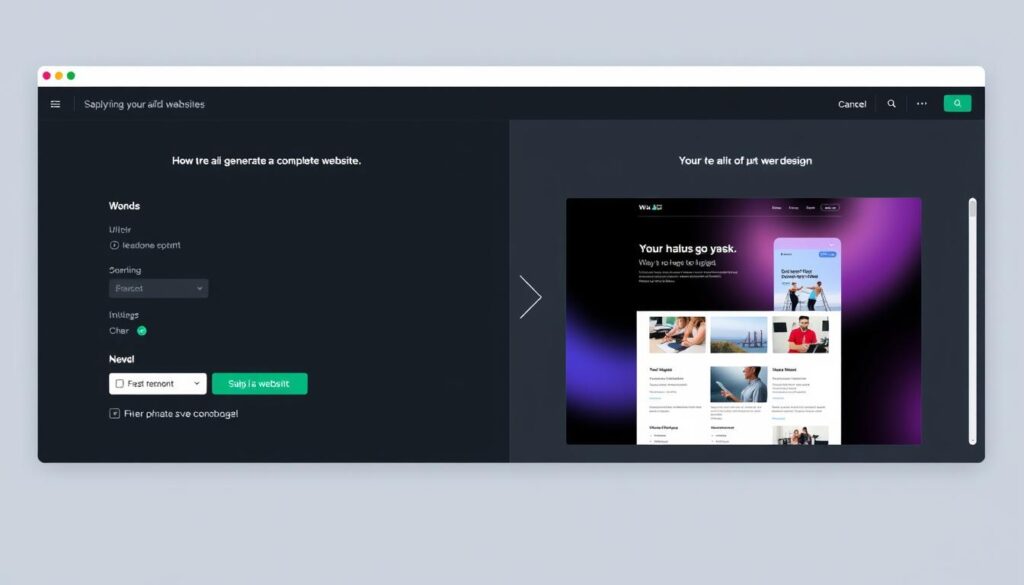
Wix ADI creating a custom website based on user preferences and content
Small Business Success with Wix ADI
A regional restaurant chain with limited technical resources needed to create consistent websites for 15 locations, each with unique menus and information. Using Wix ADI, they were able to generate the foundation for all 15 websites in just two days—a process that would have taken weeks with traditional development.
The AI system analyzed their existing branding, social media presence, and content to create cohesive designs that maintained brand consistency while accommodating location-specific information. The restaurant reported a 40% increase in online reservations after launching the new sites, attributing the improvement to better user experience and mobile optimization automatically implemented by the AI.
Figma AI Plugins: Enhancing Design Workflows
Figma’s integration of AI through various plugins has transformed how designers create and iterate on web interfaces.
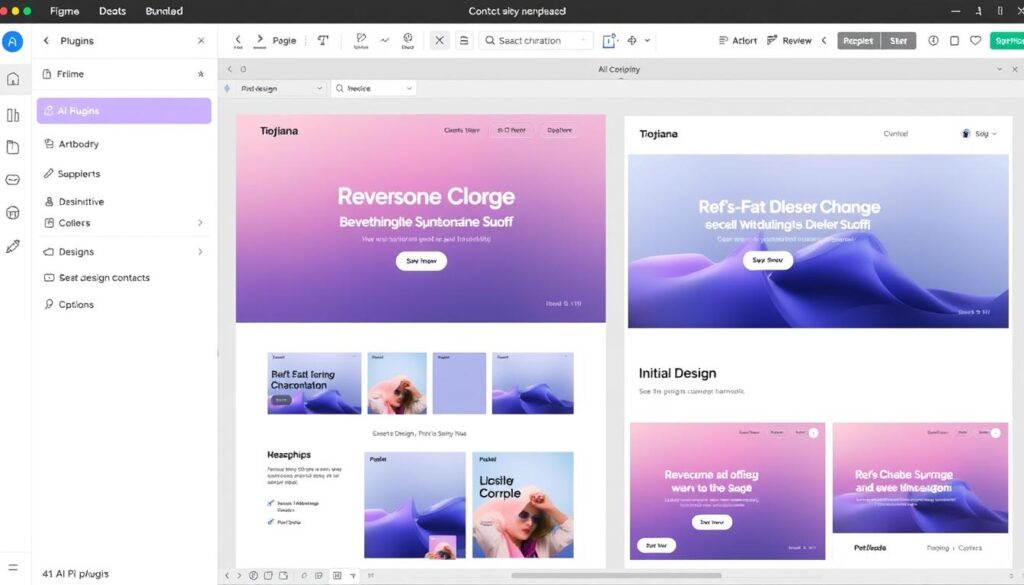
Figma AI plugins generating multiple design variations from a single concept
How a Digital Agency Scaled Design with Figma AI
A digital agency working with enterprise clients implemented Figma’s AI plugins to handle increasing design demands without expanding their team. The designers used AI to generate initial concepts based on client briefs, then refined these concepts rather than starting from scratch.
This approach allowed them to present clients with more options in less time. For one e-commerce client, they generated 12 different homepage designs in the time it would typically take to create 3-4 manually. The AI tools also helped maintain consistency across hundreds of product pages by automatically applying design patterns and adjusting layouts based on content requirements.
Efficiency Gains: The Business Impact of AI in Web Development
The integration of AI-driven web development tools delivers tangible business benefits beyond just technical improvements. These efficiency gains are transforming how organizations approach digital projects and allocate resources.
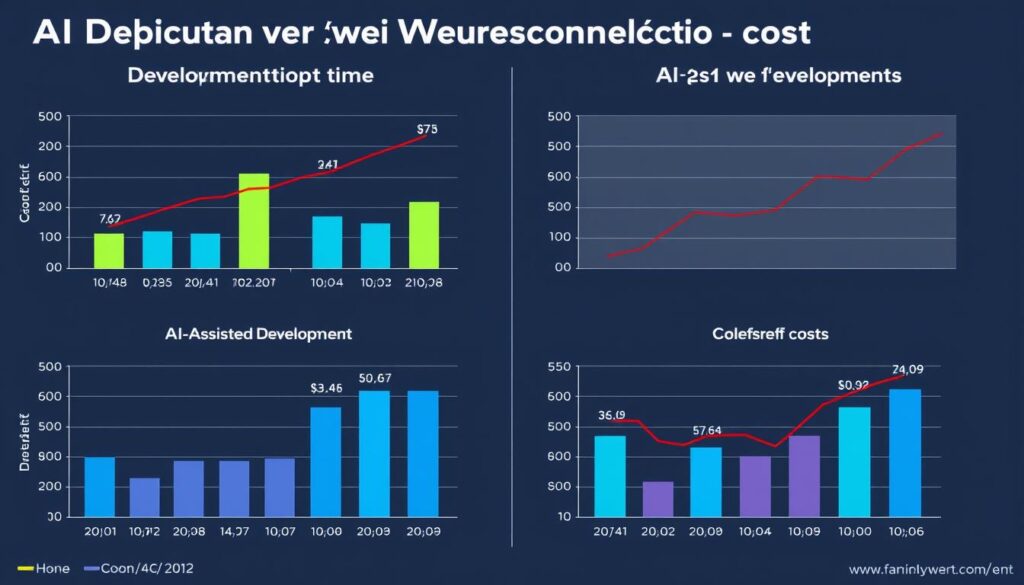
Comparison of development timelines: Traditional vs. AI-assisted approaches
Reduced Development Time and Faster Time-to-Market
AI-driven tools dramatically accelerate the development process at multiple stages, enabling businesses to launch digital products more quickly.
Research indicates that organizations implementing AI-driven web development tools experience an average reduction of 73% in development time across projects. This acceleration is particularly pronounced in frontend development and testing phases, where repetitive tasks can be efficiently automated.
Cost Reduction and Resource Optimization
The financial impact of AI tools extends beyond faster development, creating opportunities for significant cost savings and more efficient resource allocation.
Direct Cost Savings
Resource Allocation Benefits
Democratization of Web Development
Perhaps the most transformative impact of AI-driven web development tools is how they’re making sophisticated web creation accessible to non-technical users.

AI tools enable non-technical users to create professional websites independently
“AI-driven web development tools are not just changing how we build websites—they’re changing who can build them. We’re seeing small business owners and marketing teams create sophisticated web experiences that previously would have required specialized development teams.”
Transform your web development process
Join thousands of businesses already using AI to build better websites faster.
Challenges and Considerations
While AI-driven web development tools offer tremendous benefits, their implementation comes with important challenges and considerations that organizations must address.

Human oversight remains essential when working with AI-generated code
Ethical Implications and Workforce Impact
The rapid advancement of AI in web development raises important questions about its impact on the workforce and broader ethical considerations.
Opportunities
- Developers can focus on higher-value creative and strategic work
- New roles emerging in AI prompt engineering and oversight
- Increased accessibility allows more diverse participation in web creation
- Potential for more innovative solutions as routine tasks are automated
Challenges
- Potential displacement of entry-level development positions
- Risk of over-reliance on AI without understanding the underlying code
- Copyright and ownership questions around AI-generated content
- Potential for reinforcing biases present in training data
Technical Limitations and Quality Concerns
Despite impressive capabilities, current AI-driven web development tools have important limitations that must be understood and managed.
Implementation Best Practices
Organizations can maximize the benefits of AI-driven web development tools while mitigating risks by following these implementation best practices:
| Best Practice | Description | Benefits |
| Hybrid Development Approach | Combine AI automation with human oversight and intervention at key decision points | Balances efficiency gains with quality control and strategic direction |
| Clear Prompt Engineering | Develop expertise in crafting effective prompts that guide AI tools toward desired outcomes | Improves output quality and reduces iteration cycles |
| Comprehensive Testing Protocols | Implement rigorous testing of AI-generated code, including security and performance testing | Ensures reliability and identifies issues before production |
| Skill Development | Train teams on effective collaboration with AI tools and understanding of the generated code | Maximizes tool effectiveness and maintains team capabilities |
| Ethical Guidelines | Establish clear policies for AI usage, including data privacy and content ownership | Mitigates legal and ethical risks while building trust |
Key Consideration: AI-driven web development tools should be viewed as powerful collaborators rather than replacements for human developers. The most successful implementations maintain human oversight for strategic decisions, creative direction, and quality assurance.
Future Outlook: What’s Next for AI in Web Development
As AI technologies continue to evolve, the future of web development promises even more transformative capabilities. Here’s what we can expect to see emerging by 2025 and beyond.
The future of web development will feature increasingly autonomous AI systems
Self-Maintaining Websites
One of the most promising developments on the horizon is the emergence of websites that can maintain and update themselves with minimal human intervention.
AI-Driven A/B Testing and Optimization
The next generation of AI tools will take website optimization to new levels through sophisticated testing and personalization capabilities.
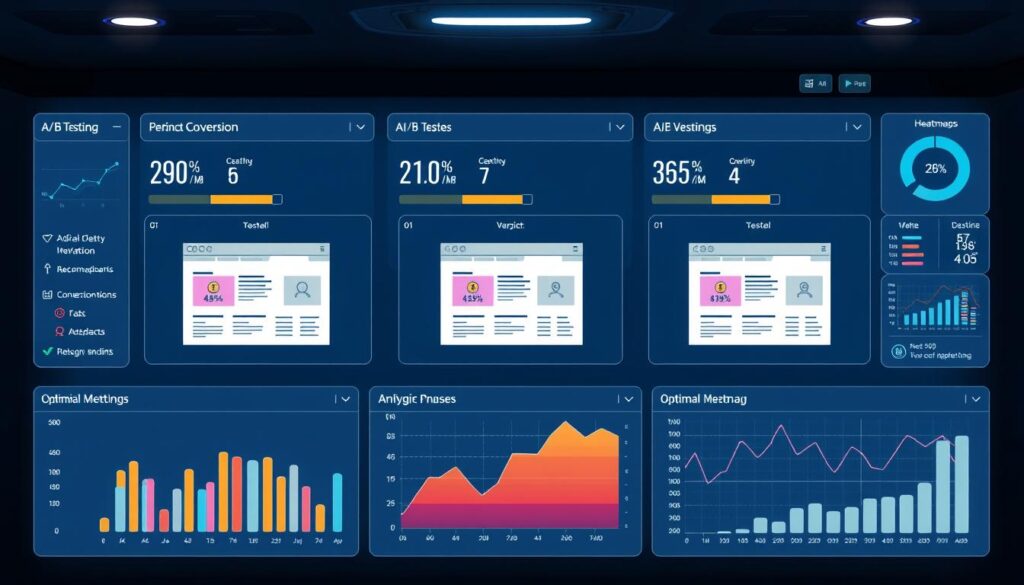
Advanced AI systems will continuously test and optimize websites autonomously
Voice and Natural Language Interfaces
The way developers interact with development tools is set to transform dramatically with the advancement of voice and natural language interfaces.
Integration of Advanced Technologies
AI-driven web development will increasingly incorporate other cutting-edge technologies to create more powerful and immersive web experiences.
Augmented Reality
AI tools will simplify the creation of AR experiences on the web, automatically generating the necessary code for interactive 3D elements and spatial awareness.
Blockchain Integration
Web development tools will facilitate the implementation of blockchain technologies for authentication, transactions, and data verification with minimal coding required.
IoT Connectivity
AI will streamline the development of web interfaces that connect with and control Internet of Things devices, creating unified experiences across digital and physical environments.
“By 2025, we expect that up to 80% of routine web development tasks will be automated through AI, allowing human developers to focus on innovation and strategic direction. The most successful organizations will be those that effectively combine human creativity with AI efficiency.”
Stay ahead of the curve
Get early access to emerging AI web development technologies and shape the future of your digital presence.
Conclusion: Embracing the AI-Driven Future of Web Development
The integration of AI-driven web development tools represents one of the most significant shifts in how digital experiences are created since the advent of responsive design. As we’ve explored throughout this article, these technologies are already delivering substantial benefits in terms of efficiency, accessibility, and innovation—and their capabilities continue to expand rapidly.

The future of web development lies in effective human-AI collaboration
For businesses and organizations, the message is clear: AI-driven web development is not just a trend but a fundamental transformation in how digital products are created. Those who embrace these tools thoughtfully—balancing automation with human oversight and creativity—will gain significant advantages in speed, cost-efficiency, and innovation capacity.
For developers, these technologies represent both a challenge and an opportunity. While some routine tasks will be automated, the demand for strategic thinking, creative problem-solving, and effective collaboration with AI systems will only increase. The most successful developers will be those who adapt their skills to complement AI capabilities rather than compete with them.
As we look toward 2025 and beyond, the continued evolution of AI in web development promises even more exciting possibilities—from self-maintaining websites to immersive experiences that blend digital and physical realities. By understanding the current landscape and preparing for emerging trends, organizations can position themselves to leverage these powerful tools for competitive advantage and digital innovation.
Ready to revolutionize your web development?
Start implementing AI-driven tools in your workflow today and experience the benefits firsthand.
Frequently Asked Questions About AI-Driven Web Development
Do AI-driven web development tools require coding knowledge?
It depends on the specific tool and your goals. Many AI website builders like Wix ADI or similar platforms require no coding knowledge at all—you can create a functional website by answering questions and providing content. More advanced AI coding assistants like GitHub Copilot enhance the productivity of developers who already know how to code, but they don’t eliminate the need for programming knowledge for complex projects. The trend is moving toward making web development increasingly accessible to non-coders, but technical knowledge still provides advantages for customization and optimization.
How accurate and reliable is AI-generated code?
AI-generated code has improved dramatically in recent years but still requires human review for critical applications. Current AI tools typically produce code that is functionally correct about 80-90% of the time for common tasks, but may not always follow best practices for performance, security, or maintainability. The reliability varies based on the complexity of the task, the quality of the prompt, and the specific AI tool being used. For production environments, implementing a review process where developers validate and optimize AI-generated code is strongly recommended.
Will AI replace web developers?
AI is unlikely to completely replace web developers, but it is changing the nature of their work. Routine and repetitive aspects of web development are increasingly being automated, allowing developers to focus on more creative, strategic, and complex tasks. The most probable future is a collaborative model where developers work alongside AI tools, using them to handle mundane tasks while providing the creative direction, business logic understanding, and quality assurance that AI cannot fully replicate. Developers who adapt their skills to effectively leverage AI tools will likely find increased demand for their expertise.
What are the costs associated with implementing AI-driven web development tools?
Costs vary widely depending on the specific tools and implementation scope. Entry-level AI website builders typically range from -100 per month for business users. Professional AI coding assistants like GitHub Copilot cost around -20 per developer per month. Enterprise-level implementations with custom AI integration can require significant investment in tools, training, and workflow adjustments. However, these costs should be evaluated against the potential savings in development time, reduced errors, and faster time-to-market. Many organizations report positive ROI within 3-6 months of implementing AI development tools due to productivity gains.
How can businesses start implementing AI in their web development process?
A phased approach works best for most organizations. Start by identifying specific pain points or repetitive tasks in your current development process that could benefit from automation. Begin with pilot projects using readily available AI tools that address these specific needs. Provide training for your team and establish clear guidelines for AI tool usage, including review processes for AI-generated code. Collect data on productivity improvements and quality metrics to evaluate effectiveness. Based on these results, gradually expand implementation to additional areas of your development workflow. This incremental approach minimizes disruption while allowing your team to build expertise with the new tools.
Additional Resources
Guides & Tutorials
Tools & Platforms
Take the next step in your AI journey
Join our community of forward-thinking developers and businesses leveraging AI to transform web development.